
Turin Astrophysical Observatory


Image: Wikimedia Commons
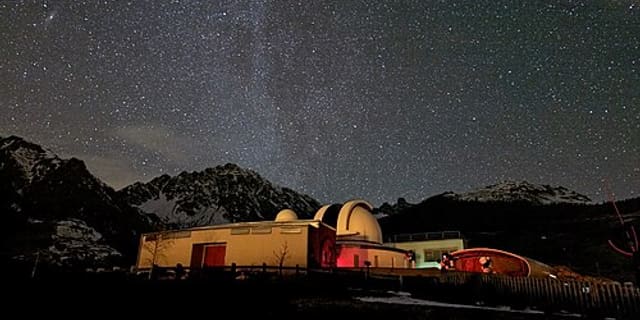
Turin Astrophysical Observatory, officially the Osservatorio Astronomico di Torino, sits atop a hill in Pino Torinese, about 15 kilometres from Turin in Italy's Piedmont region.
About Turin Astrophysical Observatory
The observatory is owned and operated by Italy's National Institute for Astrophysics (INAF), and today conducts research across extragalactic astrophysics, plasma physics, stellar science, exoplanets, solar phenomena and cosmology. It has participated in major international projects including GAIA, Euclid and Solar Orbiter.
History
Founded in 1759, the observatory originally stood on Via Po in Turin. Its first purpose-built dome, the "Specola", was constructed around 1789 on the roof of the Academy of Sciences. The observatory later moved to Palazzo Madama in 1822 under astronomer Giovanni Plana, before relocating to its current hilltop site in Pino Torinese at the end of 1912, a move led by Giovanni Boccardi. It became a research institute of INAF following a 2012 merger with the Interplanetary Space Physics Institute's Turin branch.
Telescopes & research
In the late 1920s and early 1930s, Italian astronomer Luigi Volta made several asteroid discoveries at Pino Torinese; the asteroid 2694 Pino Torinese was later named after the observatory's location. Its research today spans extragalactic astrophysics, stellar science, exoplanets, solar physics and cosmology, with involvement in international missions such as GAIA, Euclid and Solar Orbiter.
Location & getting there
The observatory sits on a hilltop in Pino Torinese, about 15 kilometres from Turin, in the Piedmont region of northern Italy.
Visiting Turin Astrophysical Observatory
As an active INAF research institute, visiting arrangements vary; check the observatory's website for current tours, open days or public events.
See your named star from here
With over 260 years of observing history and cutting-edge research today, Turin Astrophysical Observatory is a meaningful place to think about the star you've named. Name a star or browse the catalogue to find its coordinates.
Opening hours and public-visit programs vary by season. Check the official website and Google Maps for current times before you travel.
Institutional and reference sources used to verify this guide.
Satellite imagery: Esri, Maxar, Earthstar Geographics

 86 km
86 km
 92 kmPublic