
Stellarium Gornergrat
Satellite imagery: Esri, Maxar, Earthstar Geographics
High above Zermatt in the Swiss Alps, Stellarium Gornergrat sits at over 3,100 metres in the shadow of the Matterhorn — one of the highest and most dramatically located observatories in Europe.
About Stellarium Gornergrat
Stellarium Gornergrat is housed in the south tower of the Kulmhotel Gornergrat, at 3,120 metres above sea level in the canton of Valais. It was Switzerland's first remote-controlled observatory built specifically for public and educational use, and today it is run jointly by the Universities of Bern and Geneva.
History
The Gornergrat site has a long research history dating back to international astronomical work in the 1960s, but the observatory shifted its focus toward education around 2010. It officially began operating as a teaching facility for schools and the public in 2017, making it Switzerland's first observatory dedicated primarily to classroom instruction.
Telescopes & research
Its main instrument is a 60-centimetre "DeepSky telescope" built by the Italian firm Officina Stellare. The telescope can be operated remotely, allowing school classes and members of the public to take part in real observing sessions without travelling to the summit themselves.
Location & getting there
Stellarium Gornergrat is reached via the Gornergrat cog railway, completed in 1898, which climbs from Zermatt to the Kulmhotel Gornergrat. The extreme altitude and remoteness give the site minimal light pollution and panoramic views across 28 four-thousand-metre peaks, including the Matterhorn.
Visiting Stellarium Gornergrat
The observatory runs educational sessions for schools and public groups; because access depends on the railway timetable and booking arrangements, check the official Stellarium Gornergrat website before planning a visit.
See your named star from here
Because a star's coordinates don't change with the viewer's location, a star named through Star Register can be tracked down from a summit as clear as the Gornergrat. Search the star catalogue to find your own star's position in the sky.
Opening hours and public-visit programs vary by season. Check Google Maps for current times before you travel.
Institutional and reference sources used to verify this guide.
Satellite imagery: Esri, Maxar, Earthstar Geographics

 30 km
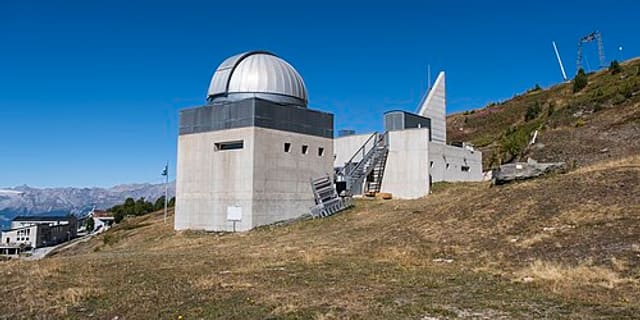
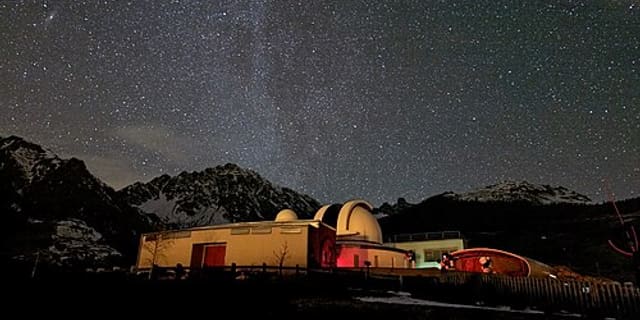
30 kmFrançois-Xavier Bagnoud Observatory
Astronomical observatory in St-Luc, Switzerland

 32 km
32 km
 34 km
34 km
 72 kmPublic