
Stephanion Observatory
Satellite imagery: Esri, Maxar, Earthstar Geographics
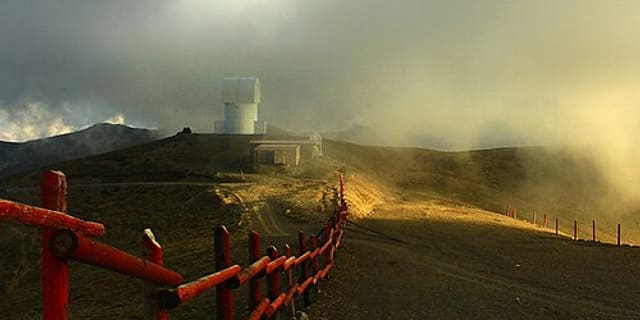
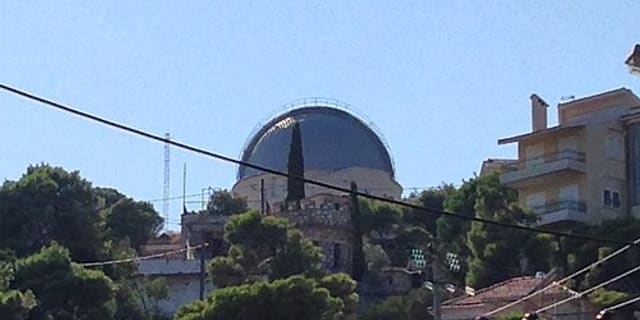
On Dragatoura Hill above the village of Stephanion, in the southern Peloponnese, Stephanion Observatory has spent more than half a century watching variable stars change brightness.
About Stephanion Observatory
Stephanion Observatory is a research station built on Dragatoura Hill in the village of Stephanion, in the southern Peloponnese region of Greece. Its work has long focused on photometric observations of variable stars, and its results have appeared in more than 100 papers in international journals.
History
The observatory made its first observations in March 1967, using a guest 38-centimetre reflector and a UBV photometer. Its main 30-inch (76-centimetre) reflector, built by Astro Mechanics in the United States and mounted asymmetrically in a Cassegrain-Coudé configuration, made it the largest telescope in Greece until the 123-centimetre Cassegrain at Kryonerion came online in 1975.
Telescopes & research
The main instrument runs at f/3 at the primary focus and f/13.5 in Cassegrain configuration. Over the decades, Stephanion's astronomers have used it for photometric studies of flare stars, Cepheid variables and RS CVn binary systems, contributing to more than a hundred publications in international astronomy journals.
Location & getting there
The observatory sits on a hilltop above the village of Stephanion in the southern Peloponnese, a rural setting that helped make it a serious research site — and one that, by local accounts, helped revive confidence and prospects in the village itself.
Visiting Stephanion Observatory
As a working research facility, visiting arrangements are not standardised for casual travellers; anyone interested in a visit should check with the observatory or affiliated university department before travelling to Stephanion.
See your named star from here
Stephanion's decades of variable-star photometry are a reminder that stars are studied by precise coordinates, not just by eye — the same coordinates that come with any star named through Star Register. Find yours in the star catalogue and see where it sits in the Peloponnesian sky.
Opening hours and public-visit programs vary by season. Check Google Maps for current times before you travel.
Institutional and reference sources used to verify this guide.
Satellite imagery: Esri, Maxar, Earthstar Geographics

 61 km
61 km
 97 kmResearch