
Chelmos Observatory

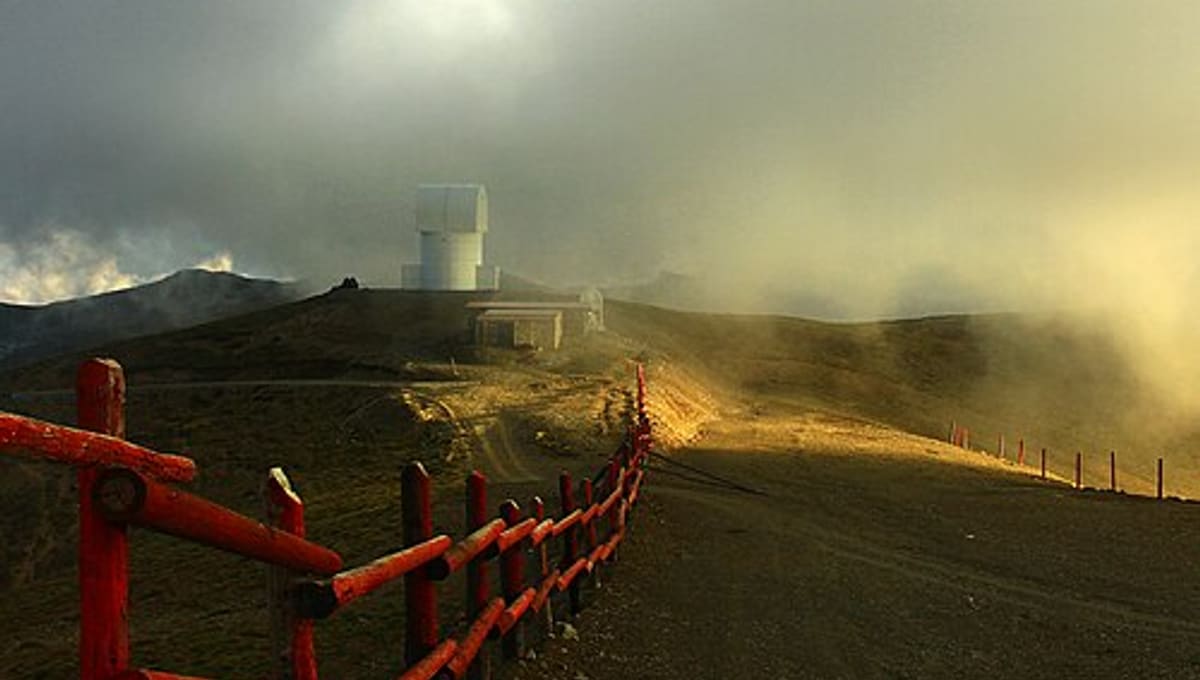
Image: Wikimedia Commons
High on Mount Chelmos in the Peloponnese, the Helmos Observatory has trained Greece's largest telescope on the sky since 2001, taking advantage of some of the darkest, clearest air left in mainland Europe.
About Chelmos Observatory
Known officially as the Helmos Observatory (Asteroskopeio Chelmou), the site sits at 2,340 metres on Mount Chelmos, also called Aroania, about 15 km from the town of Kalavryta and roughly 130 km west of Athens. It is the largest research infrastructure operated by the National Observatory of Athens (NOA) and its Institute for Astronomy, Astrophysics, Space Applications and Remote Sensing (IAASARS). NOA itself was founded in 1842, making it Greece's oldest research organisation.
History
Construction was completed and the observatory opened in 2001. Its main telescope underwent first-light testing in 2005 and became fully operational in 2007, quickly establishing itself as the largest telescope in Greece, and at the time the largest in the Balkans and the second-largest in mainland Europe.
Telescopes & research
The observatory's centrepiece is the Aristarchos Telescope, a 2.3-metre Ritchey-Chretien instrument built by the German firm Carl Zeiss AG and financed with support from the universities of Patras and Manchester. Researchers there study asteroid spin states, contact binary stars, planetary nebulae and supernova remnants, and the site takes part in international collaborations including the European Space Agency's ScyLight project and OPTICON-RadioNet Pilot. In July 2025 the observatory successfully demonstrated laser communication with NASA's Psyche spacecraft across a distance of 265 million kilometres, a striking example of its instruments being put to cutting-edge use.
Location & getting there
Sitting at 2,340 metres above sea level near Kalavryta in the Peloponnese, Helmos Observatory occupies one of the darkest, clearest sites left in Greece and Europe; the altitude and distance from city lights that make the Aristarchos Telescope so effective are the same qualities that make the drive up worthwhile for visitors. (Use the map and directions above to plan your route.)
Visiting Chelmos Observatory
The observatory welcomes visitors interested in its research and its telescope; check the official Helmos Observatory website for current opening arrangements, tours and any seasonal access restrictions before you travel, since mountain weather can affect the road up.
See your named star from here
A telescope the size of Aristarchos can resolve details far beyond what a backyard instrument can reach, and the same principle applies to any star you've named through Star Register: give an observatory its right ascension and declination, and it can be found. Look up your star's coordinates in our catalogue, or name a star if you haven't yet, then bring the details along on a visit to Helmos or another observatory near you.
Opening hours and public-visit programs vary by season. Check the official website and Google Maps for current times before you travel.
Institutional and reference sources used to verify this guide.
Satellite imagery: Esri, Maxar, Earthstar Geographics

 146 kmResearch