
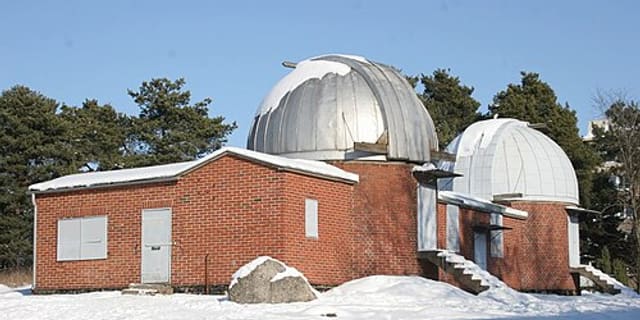
Sodankyla Magnetic Observatory
Satellite imagery: Esri, Maxar, Earthstar Geographics
Some 120 kilometres north of the Arctic Circle, in Finnish Lapland, the Sodankyla Magnetic Observatory has been quietly recording the Earth's magnetic field for well over a century. It's one of the longest continuously running geophysical stations of its kind.
About Sodankyla Magnetic Observatory
Founded in 1913 by the Finnish Academy of Science and Letters, with observations beginning in 1914, the observatory has built an unbroken geomagnetic record spanning more than 110 years. Since 1997 it has operated as an independent research department of the University of Oulu, and it has been recognised as an EPS Historic Site by the European Physical Society.
Telescopes & research
Alongside continuous geomagnetic field measurements, the observatory tracks cosmic radio noise, seismic activity and cosmic rays. It runs two ionospheric radars and supports research using the EISCAT incoherent scatter radar, and it coordinates measurement stations at 19 locations stretching from southern Finland up to Svalbard.
Location & getting there
Sodankylä sits deep in Finnish Lapland, well north of the Arctic Circle, a location that gives it a front-row seat to auroral and geomagnetic activity in the far north.
Visiting Sodankyla Magnetic Observatory
As a working research station, visiting arrangements are best confirmed with the University of Oulu's Sodankylä Geophysical Observatory before travelling.
See your named star from here
Far northern skies like these are prized for clear, dark viewing conditions, the kind of setting where a named star's coordinates can be tracked down with a telescope. If you've named a star, its position is ready to find, or browse the star catalogue for stars already named.
Opening hours and public-visit programs vary by season. Check Google Maps for current times before you travel.
Institutional and reference sources used to verify this guide.
Satellite imagery: Esri, Maxar, Earthstar Geographics

 798 km