
Rutherfurd Observatory

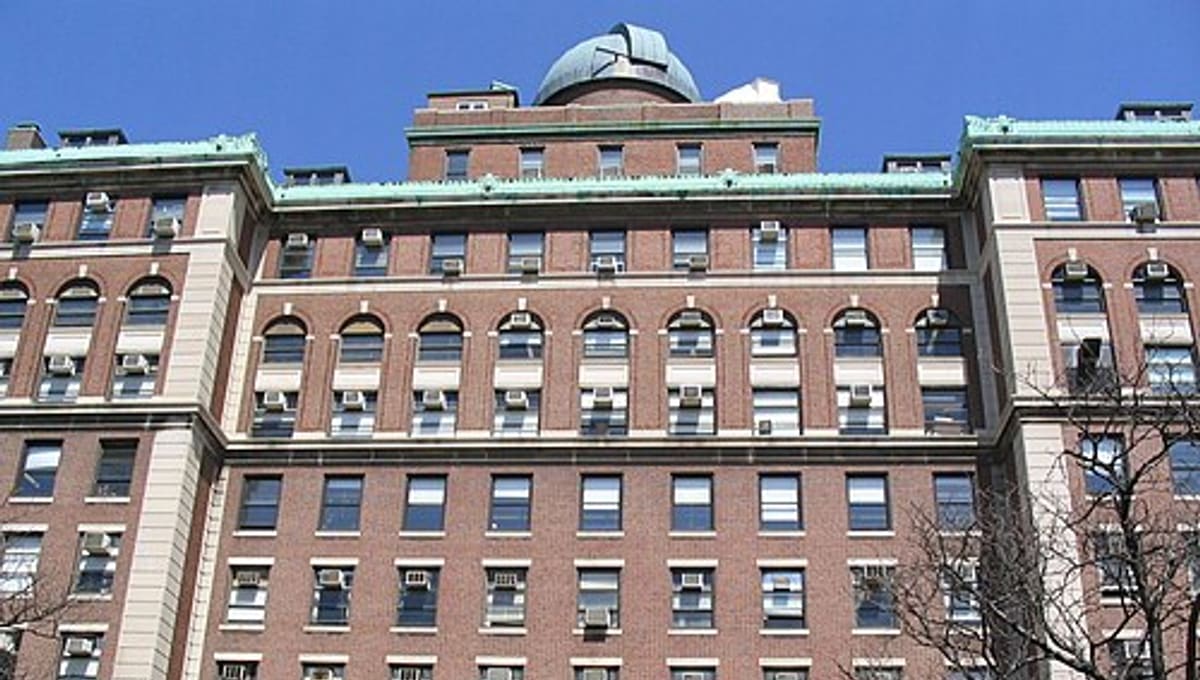
Image: Wikimedia Commons
Rutherfurd Observatory crowns the roof of Pupin Physics Laboratory at Columbia University in New York City, a working teaching observatory with roots stretching back more than a century.
About Rutherfurd Observatory
Named for Lewis Morris Rutherfurd, a 19th-century amateur astronomer and Columbia trustee who donated instruments and photographic plates to the university in 1884, the observatory has carried his name through several moves across campus. It first held telescopes in midtown Manhattan, then on the Stuyvesant Estate, before settling atop Pupin Hall when the building was completed in 1927.
History
Rutherfurd Observatory has operated continuously since 1927. One floor below it, in Wallace Eckert's Astronomical Laboratory, the first device built to perform general scientific calculations automatically was constructed in 1933-34. In the 1970s, the Columbia CO Survey erected a 1.2-metre radio telescope on the Little Dome, the first instrument to map the sky in that important radio band. Since 2009, a new Northwest Corner Building six floors taller than Pupin has blocked part of the observatory's field of view and added stray light, complicating observations.
Telescopes & research
The observatory today is equipped with two Schmidt-Cassegrain telescopes, an 11-inch Celestron and a 14-inch Meade, housed in a retractable dome. It once held a 12-inch Alvan Clark refractor built in 1916, used for decades in student teaching before being sold to the South Carolina State Museum in 1997, which specialises in preserving historic Alvan Clark instruments.
Location & getting there
The observatory sits on the Morningside Heights campus in Upper Manhattan, easily reached by New York City's subway network. Its rooftop setting offers city dwellers a rare chance to look through a telescope without leaving Manhattan.
Visiting Rutherfurd Observatory
Columbia runs free public lectures and stargazing nights at Rutherfurd Observatory through the year, alongside educational activities for students and visitors. Check the university's current events listings for dates, since access is by scheduled sessions rather than daily open hours.
See your named star from here
Even amid Manhattan's bright skyline glow, the coordinates of a star named through Star Register remain fixed and findable. Visit the catalogue to look up a named star's position, then bring it to a public night at Rutherfurd Observatory to see how the sky above Pupin Hall lines up with it.
Opening hours and public-visit programs vary by season. Check Google Maps for current times before you travel.
Institutional and reference sources used to verify this guide.
Satellite imagery: Esri, Maxar, Earthstar Geographics
Astrophysical Observatory of the College of Staten Island
astronomical observatory

 53 km
53 kmDaniel S. Schanck Observatory
historical astronomical observatory in New Brunswick, New Jersey