
NJIT Observatory
Satellite imagery: Esri, Maxar, Earthstar Geographics
NJIT Observatory is an astronomical observatory in New Jersey, United States, operated by the New Jersey Institute of Technology's Center for Solar-Terrestrial Research (CSTR).
About NJIT Observatory
NJIT Observatory is run by the New Jersey Institute of Technology's Center for Solar-Terrestrial Research (CSTR), a group focused on solar observation and space weather. CSTR operates a network of facilities beyond New Jersey itself, including the Big Bear Solar Observatory in California, the Owens Valley Solar Array, also in California, and a set of Automated Geophysical Observatories on the Antarctic ice shelf.
Telescopes & research
The centrepiece of NJIT's solar research network is the Big Bear Solar Observatory's Goode Solar Telescope, a 1.6-metre aperture instrument and one of the most advanced solar telescopes in the world, located on the shore of Big Bear Lake in California's San Bernardino Mountains. Alongside it, the Owens Valley Solar Array (OVSA) contributes radio observations of the Sun, while the Antarctic Automated Geophysical Observatories extend the network's reach to polar space weather monitoring. Together, these facilities support NJIT's broader work in solar-terrestrial research and space weather forecasting.
Location & getting there
NJIT Observatory itself is based in New Jersey, part of NJIT's home turf in the North America region, while its sister facilities span California and Antarctica as part of the same research network.
Visiting NJIT Observatory
For current information on tours or public access, check the websites of NJIT's Center for Solar-Terrestrial Research and its individual facilities, including bbso.njit.edu and ovsa.njit.edu.
See your named star from here
NJIT's telescopes are built to track the Sun with precision, using the same right-ascension-and-declination coordinate system that pinpoints every star named through Star Register. Browse the catalogue to find a star, or choose a naming package to name one yourself.
Opening hours and public-visit programs vary by season. Check Google Maps for current times before you travel.
Institutional and reference sources used to verify this guide.
Satellite imagery: Esri, Maxar, Earthstar Geographics
Astrophysical Observatory of the College of Staten Island
astronomical observatory

 20 kmResearch
Rutherfurd Observatory
astronomical facility maintained by Columbia University

 35 km
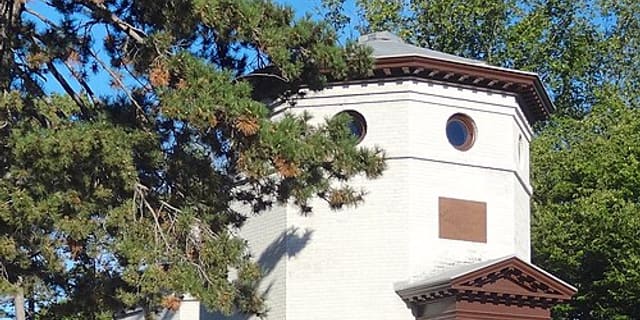
35 kmDaniel S. Schanck Observatory
historical astronomical observatory in New Brunswick, New Jersey

 61 km
61 km