
Royal Observatory

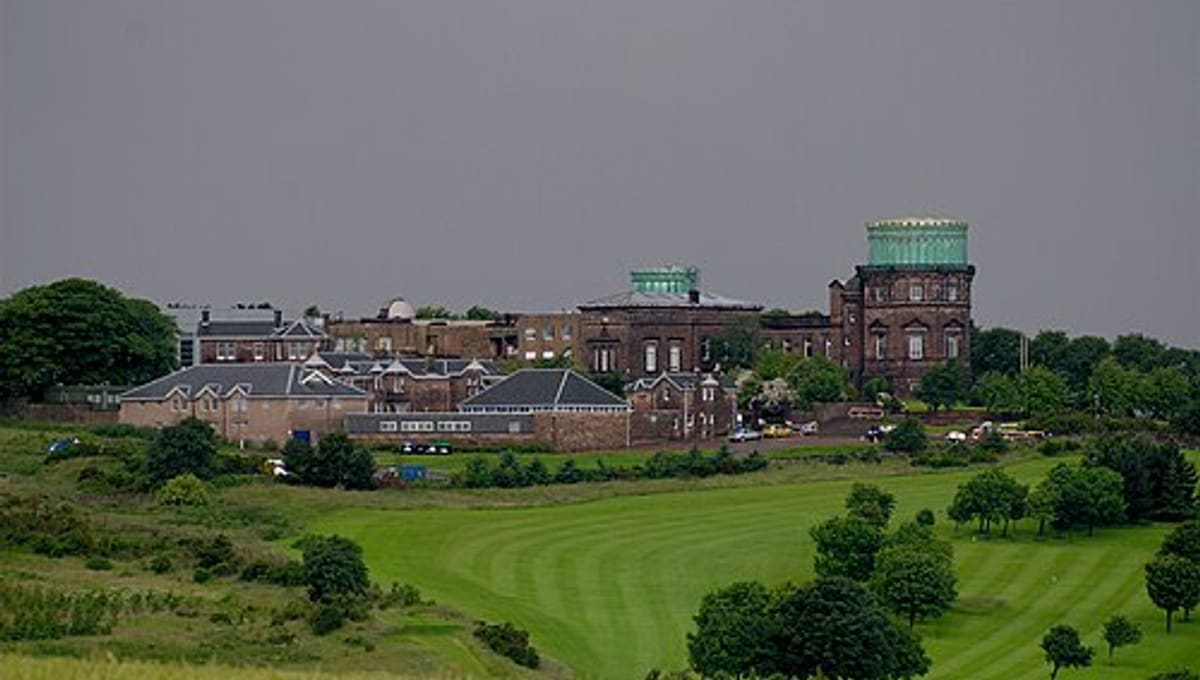
Image: Wikimedia Commons
The Royal Observatory, Edinburgh sits atop Blackford Hill, an extinct volcanic plug overlooking the city, and today combines active research, instrument-building, and public outreach.
About the Royal Observatory, Edinburgh
The Royal Observatory opened on Blackford Hill on 7 April 1896, after relocating from earlier sites at Calton Hill and Dunecht, under the direction of Ralph Copeland, the third Astronomer Royal for Scotland who oversaw the move. Its main building runs east to west for around 180 feet, with octagonal towers at each end; the site was chosen partly because Blackford Hill's bedrock — the plug of an extinct volcano — gives telescope piers a famously stable foundation, and because the prevailing wind carried the city's smoke away from the domes.
History
The observatory's original instruments included a 15-inch (38 cm) refractor housed in the East Dome and a 24-inch (0.6 m) reflector in the West Dome. Today the site is owned by the Science and Technology Facilities Council (STFC) and comprises three institutions: the UK Astronomy Technology Centre, the University of Edinburgh's Institute for Astronomy, and the ROE Visitor Centre. Its library holds the Crawford Collection, a set of astronomical books and manuscripts gifted in 1888 by the 26th Earl of Crawford.
Telescopes & research
Beyond its historic refractor and reflector, the Royal Observatory today is a hub for designing, project-managing, and building instruments and telescopes for observatories worldwide, alongside university-level astronomy research and teacher training in astronomy.
Location & getting there
Blackford Hill rises in the south of Edinburgh, Scotland, offering panoramic views over the city and, at night, comparatively dark skies for an urban setting.
Visiting the Royal Observatory, Edinburgh
The ROE Visitor Centre runs public outreach and events at the site. Check the Royal Observatory Edinburgh website for current opening times and visitor information before you go.
See your named star from here
Standing on the same hill where instrument-makers design telescopes for observatories around the world is a fitting spot to think about your own named star. Name a star, or find one already registered in the star catalogue.
Opening hours and public-visit programs vary by season. Check the official website and Google Maps for current times before you travel.
Institutional and reference sources used to verify this guide.
Satellite imagery: Esri, Maxar, Earthstar Geographics

 3 kmMuseum
 4 km
4 km
 50 kmPublic