
Swilken Brae observatory
Satellite imagery: Esri, Maxar, Earthstar Geographics
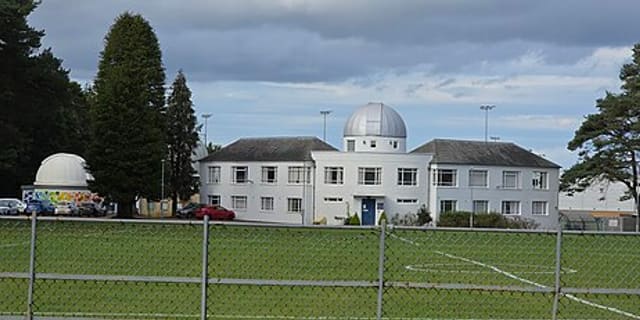
Tucked beside Buchanan Gardens in St Andrews, Scotland, the Swilken Brae observatory is the University of St Andrews' working home for astronomical research, teaching and public stargazing.
About Swilken Brae observatory
Operated by the University of St Andrews, the observatory brings together several telescopes under one roof: instruments ranging from 6cm up to 94cm in aperture serve everyone from first-year students to research astronomers. The Napier building alone houses two Schmidt-Cassegrain telescopes, 25cm and 40cm across, used mainly for undergraduate teaching.
History
The observatory was founded in 1940 under its first director, Erwin Finlay-Freundlich, a physicist who had earlier worked alongside Albert Einstein on tests of general relativity. It has grown over the following decades into one of the UK's most active university observatories.
Telescopes & research
Its flagship instrument is the James Gregory Telescope, a 37-inch (94cm) Schmidt-Cassegrain that was inaugurated in 1962 and remains the largest operating optical telescope in the United Kingdom. Alongside it, the smaller Napier telescopes support hands-on teaching, and the site regularly hosts public open nights and guided tours.
Location & getting there
The observatory sits at Swilken Brae, off Buchanan Gardens, on the edge of the historic university town of St Andrews in Scotland. It's an easy walk from the town centre, making it one of the more accessible research observatories to reach without a car.
Visiting Swilken Brae observatory
The University of St Andrews runs public open nights and guided tours at the observatory as part of its outreach programme. Check the university's observatory pages for current dates and booking details before you go, since sessions depend on the academic calendar and clear skies.
See your named star from here
With the UK's largest optical telescope on site, Swilken Brae is a fitting place to think about your own patch of sky. Once you name a star through Star Register, its coordinates are listed in our star catalogue — bring them along, and observatory staff can tell you whether it's visible from here on a given night.
Opening hours and public-visit programs vary by season. Check Google Maps for current times before you travel.
Institutional and reference sources used to verify this guide.
Satellite imagery: Esri, Maxar, Earthstar Geographics

 under 1 km
 18 kmMuseum
 40 km
40 km
 48 km
48 km