
Roque de los Muchachos Observatory

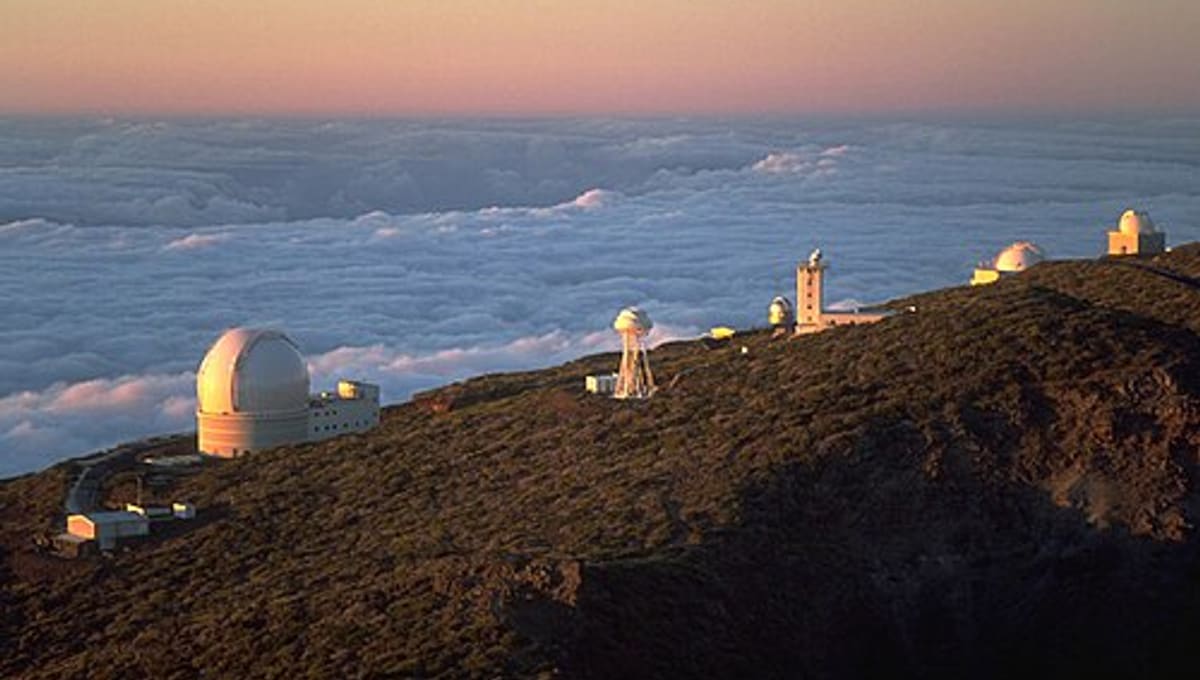
Image: Wikimedia Commons
Roque de los Muchachos Observatory sits at 2,396 metres above sea level on La Palma in Spain's Canary Islands, ranked among the very best sites in the world for optical and infrared astronomy.
About Roque de los Muchachos Observatory
Operated by the Instituto de Astrofísica de Canarias (IAC), based on neighbouring Tenerife, the observatory is part of the European Northern Observatory and hosts telescopes contributed by Britain, the Netherlands, Spain, and other nations. Its seeing conditions make it the second-best location for optical and infrared astronomy in the Northern Hemisphere, surpassed only by Mauna Kea in Hawaii.
History
The observatory was established in 1985, the result of fifteen years of international cooperation between several countries. Its telescopes include instruments relocated from Herstmonceux Castle and the Royal Greenwich Observatory, among them the Isaac Newton Telescope, originally a 98-inch instrument that was upgraded to 100 inches (2.54 metres) once installed on La Palma.
Telescopes & research
The site's fleet of telescopes includes the 10.4-metre Gran Telescopio Canarias, which was the world's largest single-aperture optical telescope as of July 2009, alongside the William Herschel Telescope, the second largest in Europe, and the adaptive-optics-corrected Swedish 1-metre Solar Telescope.
Location & getting there
The observatory occupies a mountaintop site in the municipality of Garafía on La Palma, high above the clouds at 2,396 metres, a location chosen precisely for its exceptionally stable, dark skies.
Visiting Roque de los Muchachos Observatory
Visiting arrangements for this working research site are managed by the Instituto de Astrofísica de Canarias; check their official website for current tour options and any access restrictions before planning a trip up the mountain.
See your named star from here
Few skies on Earth are better suited to spotting a single star than the one above Roque de los Muchachos. Name a star and bring its exact coordinates from our catalogue on your visit.
Opening hours and public-visit programs vary by season. Check the official website and Google Maps for current times before you travel.
Institutional and reference sources used to verify this guide.
Satellite imagery: Esri, Maxar, Earthstar Geographics
Nordic Optical Telescope observatory
astronomical observatory complex at Roque de los Muchachos Observatory

 2 km
2 km
 2 km
2 km