
Pulkovo Observatory

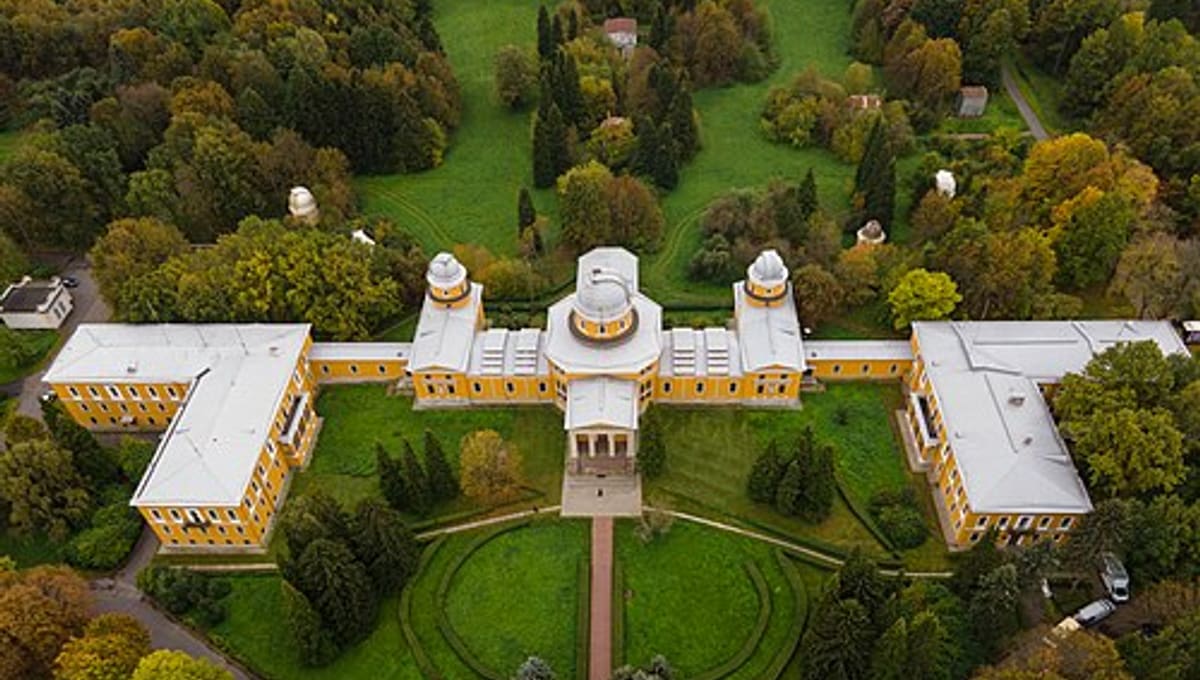
Image: Wikimedia Commons
Pulkovo Observatory has stood on Pulkovo Heights south of Saint Petersburg, Russia, since 1839, and for much of the 19th century was regarded as the astronomical capital of the world.
About Pulkovo Observatory
Officially the Central Astronomical Observatory of the Russian Academy of Sciences at Pulkovo, the site sits 75 metres above sea level, 19 kilometres south of Saint Petersburg, and is part of the UNESCO World Heritage-listed Historic Centre of Saint Petersburg and Related Groups of Monuments.
History
The observatory opened on 7 August 1839 under its first director, Friedrich Georg Wilhelm von Struve, in a building designed by architect Alexander Bryullov. Its original 38-centimetre refracting telescope was the largest in the world at the time, and Pulkovo's astronomers went on to develop precise astrometric observation methods and compile the renowned Pulkovo fundamental stellar catalogues.
Telescopes & research
Pulkovo Observatory remains the principal astronomical observatory of the Russian Academy of Sciences, continuing a tradition of high-accuracy positional astronomy that earned it its 19th-century reputation.
Location & getting there
The observatory sits at 75 metres elevation on Pulkovo Heights, 19 kilometres south of central Saint Petersburg, Russia.
Visiting Pulkovo Observatory
As a working research institution and UNESCO-listed heritage site, Pulkovo Observatory is best visited by checking its official website for current public access and tour information before travelling.
See your named star from here
Nearly two centuries of precision star-cataloguing make Pulkovo Observatory a fitting place to look for the coordinates of a star named through Star Register. Name a star or search the catalogue for one already listed.
Opening hours and public-visit programs vary by season. Check Google Maps for current times before you travel.
Institutional and reference sources used to verify this guide.
Satellite imagery: Esri, Maxar, Earthstar Geographics

 455 km
 480 km
 523 kmRadio