
Pear Tree observatory
Satellite imagery: Esri, Maxar, Earthstar Geographics
In the Florida Panhandle near Niceville, Pear Tree Observatory is a private research facility dedicated to tracking asteroids and comets rather than public stargazing.
About Pear Tree Observatory
The observatory holds IAU observatory code H23, assigned on 14 June 2009, and has been submitting positional observations to the Minor Planet Center since that year. Its main focus is verifying and refining the orbits of minor planets and comets, work that feeds directly into the global catalogue of solar system objects.
Telescopes & research
Pear Tree Observatory is equipped for minor planet and comet observation, along with meteor and planetary imaging. Alongside its research role, it supports educational and outreach programs run by the NorthWest Florida Astronomy Association and the Escambia Amateur Astronomers' Association.
Location & getting there
The observatory sits in the Florida Panhandle, a region whose relatively low light pollution compared to the state's more developed coasts makes it a workable site for the faint, moving targets that minor-planet astrometry requires.
Visiting Pear Tree Observatory
As a private research observatory, Pear Tree is not generally open to the public in the way a visitor centre would be; outreach happens mainly through its partner astronomy associations, so check with them for public events.
See your named star from here
The same precise coordinates that let Pear Tree Observatory track a moving asteroid can be used to locate a fixed star. Once you name a star with Star Register, you can look it up by its RA and Dec, and browse other named stars in our catalogue.
Opening hours and public-visit programs vary by season. Check Google Maps for current times before you travel.
Institutional and reference sources used to verify this guide.
Satellite imagery: Esri, Maxar, Earthstar Geographics

 317 kmResearch
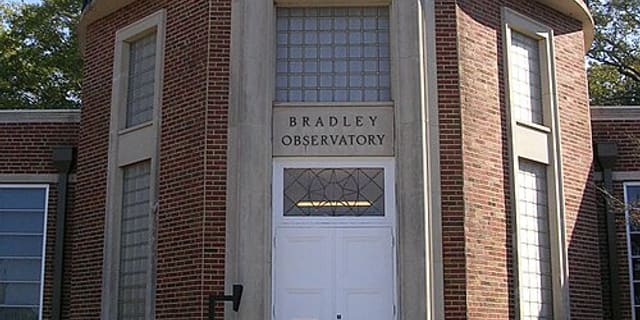
Old University of Alabama Observatory
observatory in Alabama, United States of America

 418 km
 438 km