
Owens Valley Radio Observatory

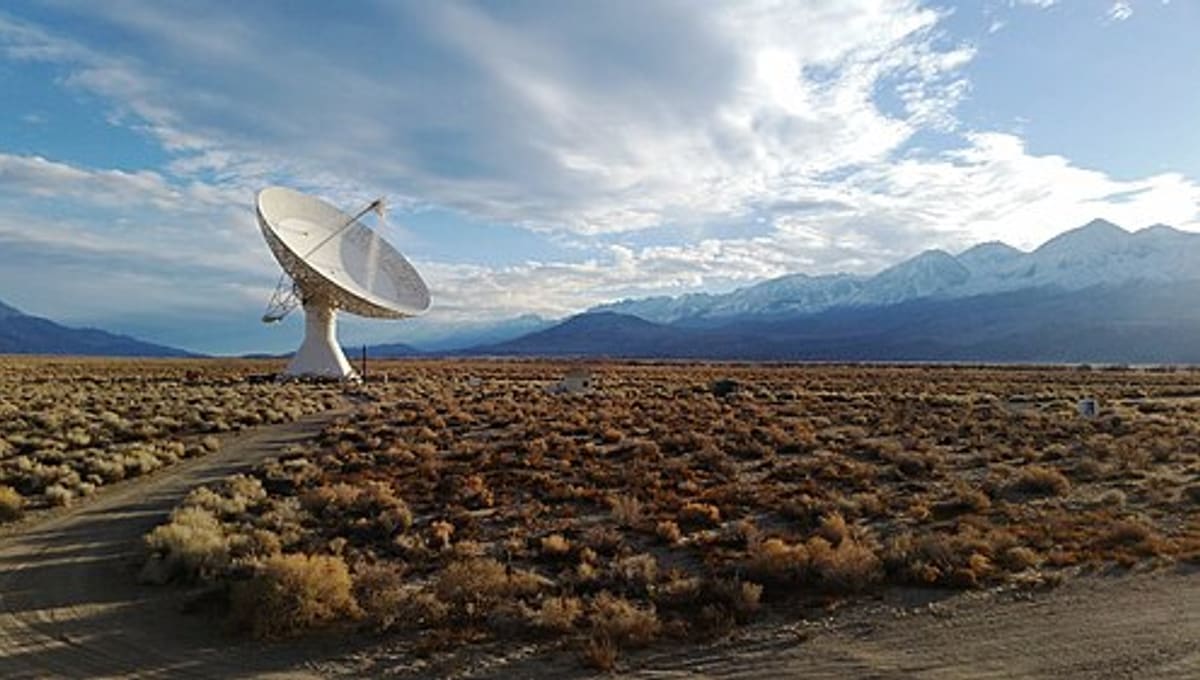
Image: Wikimedia Commons
Owens Valley Radio Observatory (OVRO) is a radio astronomy facility near Big Pine, California, set in the Owens Valley east of the Sierra Nevada, about 220 miles north of Los Angeles and 12 miles southeast of Bishop.
About Owens Valley Radio Observatory
OVRO has been owned and operated by the California Institute of Technology (Caltech) since it was established in 1956, making it one of the longer-running radio observatories in the United States. The site sits at an elevation of 1,222 metres (4,009 feet).
History
Since 1997, the Owens Valley Solar Array portion of the site has been managed separately by the New Jersey Institute of Technology (NJIT), reflecting the observatory's growth into a multi-institution research campus over the decades.
Telescopes & research
OVRO's instruments include the 40-metre Telescope with its KuPol receiver, the Expanded Owens Valley Solar Array (EOVSA), the 288-dipole Owens Valley Long Wavelength Array, and the Deep Synoptic Array (DSA-110). One of the ten dish antennas of the Very Long Baseline Array is also sited here under sublease. Research at OVRO spans radio sources, hydrogen clouds, galaxy formation, active galactic nuclei such as blazars, and the fast radio bursts that have become a major focus of modern radio astronomy.
Location & getting there
The observatory sits in North America, in California's Owens Valley, a high desert basin between the Sierra Nevada and the White Mountains, reachable from Bishop or Big Pine.
Visiting Owens Valley Radio Observatory
For current tour information and contact details, check the official OVRO website or call the observatory before travelling, as radio observatories often restrict public access around active instruments.
See your named star from here
OVRO's dishes are built to point at exact coordinates across the sky, the same principle that lets any observatory locate a star named through Star Register. Name a star and find its position in our catalogue.
Opening hours and public-visit programs vary by season. Check the official website and Google Maps for current times before you travel.
Institutional and reference sources used to verify this guide.
Satellite imagery: Esri, Maxar, Earthstar Geographics
Sierra Remote observatory
astronomical observatory in California, United States
Nora and Hashem Naraghi Hall of Science
Science building located on the California State University, Stanislaus campus

 237 kmRadio
Jack C. Davis Observatory
astronomical observatory in Nevada, United States