
Onsala Space Observatory

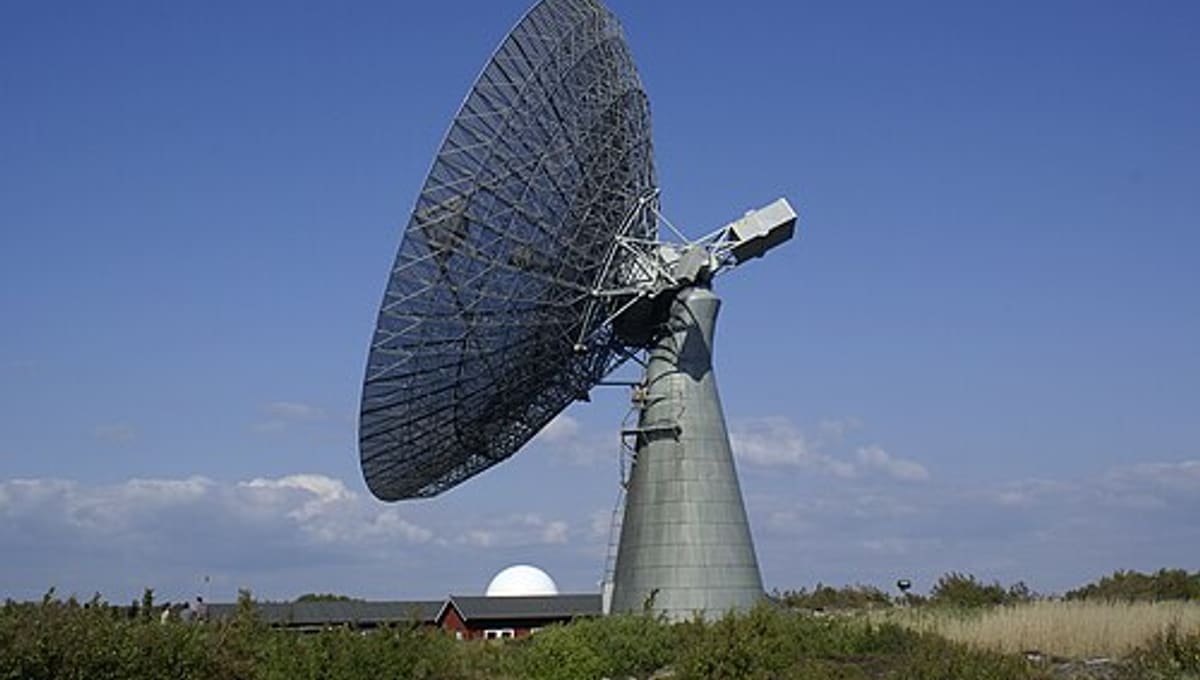
Image: Wikimedia Commons
On the coast south of Gothenburg, Onsala Space Observatory has served as Sweden's national radio astronomy facility since the middle of the 20th century, linking local research to some of the world's largest international astronomy projects.
About Onsala Space Observatory
Onsala Space Observatory (OSO) is the Swedish National Facility for Radio Astronomy, located in Onsala, about 45 kilometres south of Gothenburg, at an elevation of roughly 20 metres. It is hosted by the Department of Earth and Space Science at Chalmers University of Technology and operated on behalf of the Swedish Research Council.
History
The observatory was founded in 1949 by Professor Olof Rydbeck, establishing what would become Sweden's principal hub for radio astronomy research.
Telescopes & research
Onsala operates two radio telescopes, including a 25.6-metre polar-mount dish with receivers covering frequencies up to 7 GHz, used to study the birth and death of stars and molecules in the Milky Way and other galaxies. The site also hosts a Swedish LOFAR station completed in 2011 and has run VLBI observations since 1968, among the longest continuous time series of its kind in Europe. Onsala takes part in major international collaborations including ALMA, e-VLBI, the Herschel Space Observatory, the Square Kilometre Array, APEX, the Odin satellite mission, space geodesy work, and the Event Horizon Telescope project, alongside its own receiver development laboratories.
Location & getting there
The observatory occupies a low-lying coastal site in Onsala, in the Halland region of southwestern Sweden, within easy reach of Gothenburg.
Visiting Onsala Space Observatory
For current opening times, tours, or event details, check the observatory's official Chalmers University website before planning a trip, as access to a working research facility can vary.
See your named star from here
Onsala's telescopes are built to trace precise coordinates across the sky, which is exactly the kind of data behind a named star. Name a star with Star Register or browse the star catalogue to find its position, then use that reference point on your own stargazing visit.
Opening hours and public-visit programs vary by season. Check the official website and Google Maps for current times before you travel.
Institutional and reference sources used to verify this guide.
Satellite imagery: Esri, Maxar, Earthstar Geographics

 172 km
 172 km
 176 km