
OCA-DLR Asteroid Survey
Satellite imagery: Esri, Maxar, Earthstar Geographics
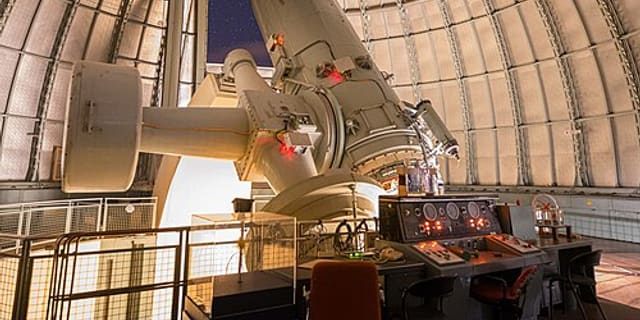
The OCA–DLR Asteroid Survey site, high on the Calern plateau in southeastern France, was where a French-German research project quietly reshaped what astronomers knew about near-Earth objects in the late 1990s.
About the OCA–DLR Asteroid Survey
The OCA–DLR Asteroid Survey (ODAS) was a collaboration between the French Observatoire de la Côte d'Azur (OCA) and the German Aerospace Center (DLR), set up to search for small Solar System bodies with a particular focus on near-Earth objects.
History
ODAS ran from 1996 to 1999. In that short window it is credited with discovering one comet and more than 1,000 minor planets, a striking output for a single European survey program of its time.
Location & getting there
The site sits at 1,271 metres elevation in Europe, on the Observatoire de la Côte d'Azur's grounds near Calern in southeastern France - a high-altitude location chosen for clear, stable skies well suited to systematic sky surveys.
Visiting the site
ODAS was a time-limited research survey rather than a public-facing observatory, and it concluded in 1999. The underlying Observatoire de la Côte d'Azur site continues as a working research facility, so anyone interested in current access should check the observatory's official channels rather than expect a general-admission visitor center.
See your named star from here
A site built for scanning the sky for faint, moving objects is a fitting place to think about a star you have named through Star Register - fixed points against the same background this survey once combed for asteroids. Find your star's exact coordinates in the star catalogue.
Opening hours and public-visit programs vary by season. Check Google Maps for current times before you travel.
Institutional and reference sources used to verify this guide.
Satellite imagery: Esri, Maxar, Earthstar Geographics

 30 km
30 km
 30 km
30 km
 99 km
99 km