
Observatorio UCM
Satellite imagery: Esri, Maxar, Earthstar Geographics
On the Moncloa campus of the Universidad Complutense de Madrid, the Observatorio UCM has studied the sky above Spain's capital since it was built in 1970 - including the challenge of doing so under the city's own light pollution.
About Observatorio UCM
The observatory belongs to the Department of Earth Physics and Astrophysics within the Faculty of Physical Sciences, and holds the Minor Planet Center observatory code I86. Its research includes work on how Madrid's light pollution affects astronomical observations, as well as studies of meteorites and other astronomical phenomena.
Telescopes & research
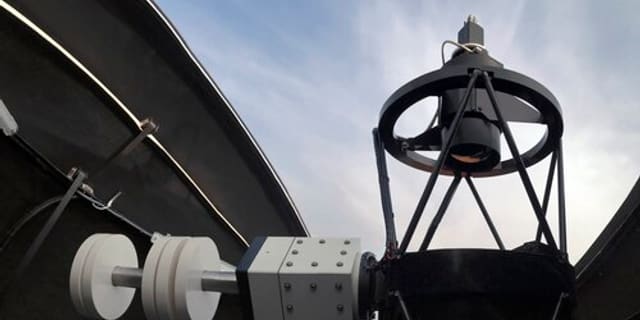
Instruments on site include two Schmidt-Cassegrain telescopes, with 12-inch and 10-inch apertures, a Pictor 216XT CCD camera, solar filters, and a solar spectrograph for observing the Sun.
Location & getting there
The observatory sits at around 656 metres elevation on the Moncloa (Ciudad Universitaria) campus of the Universidad Complutense de Madrid, in the heart of the Spanish capital.
Visiting Observatorio UCM
As a university department facility within Madrid's Ciudad Universitaria, visiting is generally arranged through the university rather than on a fixed public schedule; checking with the department ahead of time is recommended.
See your named star from here
Even from within a major capital city, this observatory's telescopes can be turned toward the coordinates of a star named through Star Register. Look up your star's exact position in the catalogue before arranging a visit.
Opening hours and public-visit programs vary by season. Check Google Maps for current times before you travel.
Institutional and reference sources used to verify this guide.
Satellite imagery: Esri, Maxar, Earthstar Geographics

 19 kmResearch
 54 kmRadio
 54 km
54 km