
ESA Cebreros TBT Observatory

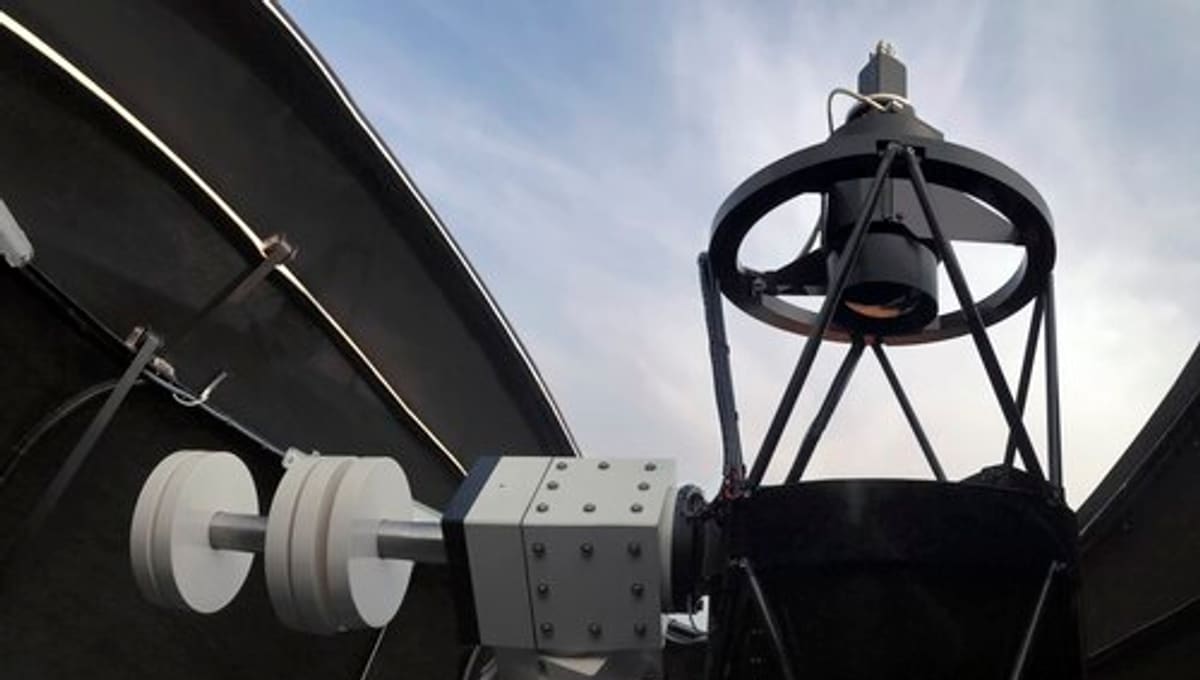
Image: Wikimedia Commons
At the ESA Cebreros ground station, 77 kilometres west of Madrid, Spain, a specialised telescope scans the night sky every clear night searching for asteroids that could come close to Earth.
About ESA Cebreros TBT Observatory
The Test-Bed Telescope (TBT) at Cebreros is one half of a twin-telescope system; its partner instrument sits at ESO's La Silla Observatory in Chile's Atacama Desert. Together they autonomously scan the sky each night, hunting for near-Earth objects (NEOs) that current surveys might otherwise miss.
Telescopes & research
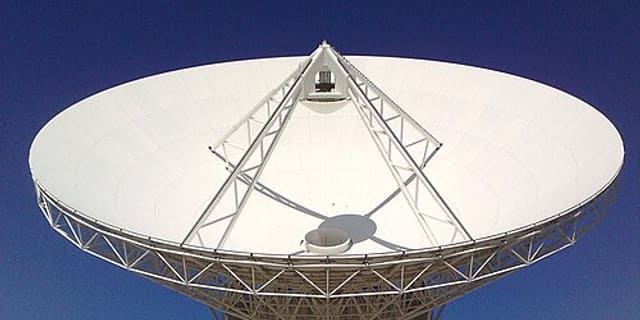
The Cebreros telescope is a fast astrograph with a 2.5 by 2.5 square-degree field of view and a plate scale of 2.2 arcseconds per pixel, mounted on a fast direct-drive system capable of slewing up to 20 degrees per second. Its detection software and hardware are optimised for spotting both near-Earth objects and high Earth orbit objects moving at 0.1 to 40 arcseconds per second. The wider Cebreros site is also home to ESA's Deep Space Antenna 2 (DSA 2), a 35-metre dish that handles X-band transmission and reception plus K- and Ka-band reception for deep-space missions, alongside tracking, telemetry, telecommand and radiometric measurements such as ranging, Doppler and meteorological data.
Location & getting there
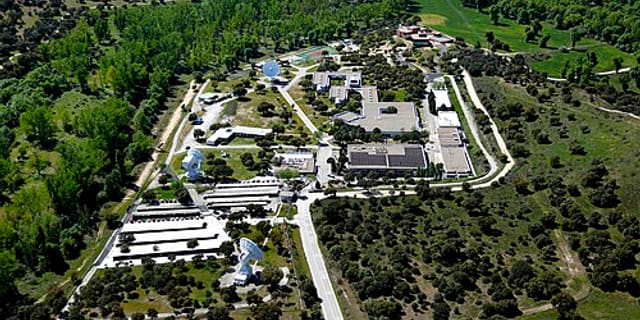
The observatory is part of the ESA Cebreros ground station in Spain, roughly 77 kilometres west of Madrid.
Visiting ESA Cebreros TBT Observatory
As an operational ESA facility, Cebreros is not generally open to casual visitors. Check with the European Space Agency for any organised tours or open-day events before planning a trip.
See your named star from here
A telescope built to track objects moving tens of arcseconds per second across the sky can certainly find something as fixed and precise as a named star's coordinates. Look up its exact position in our star catalogue.
Opening hours and public-visit programs vary by season. Check Google Maps for current times before you travel.
Institutional and reference sources used to verify this guide.
Satellite imagery: Esri, Maxar, Earthstar Geographics

 under 1 kmRadio
 35 kmResearch
 93 km
93 km