
Monte Mario Observatory

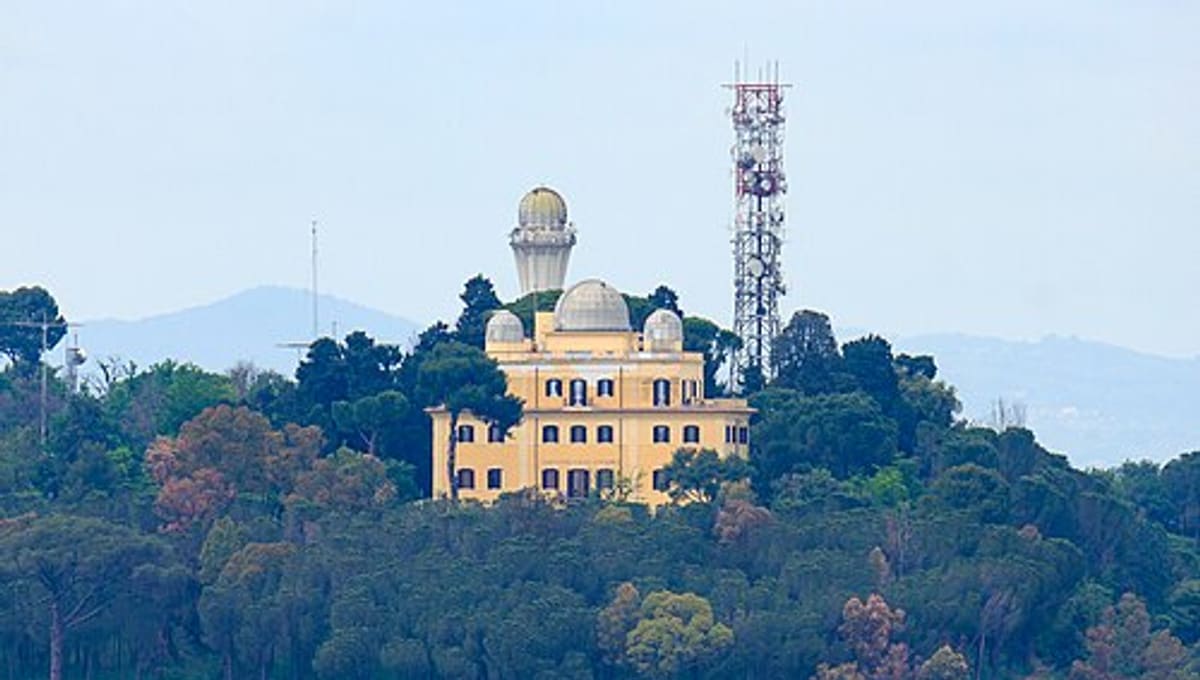
Image: Wikimedia Commons
Atop Monte Mario, overlooking the right bank of the river Tiber in Rome, Italy, this observatory has watched the sky over the Eternal City for well over a century.
About Monte Mario Observatory
Monte Mario Observatory is administratively part of the Observatory of Rome (Osservatorio Astronomico di Roma) and has served as the seat of the Istituto Nazionale di Astrofisica (INAF) since 2002. It is housed inside Villa Mellini, a building originally constructed in the 15th century, and its grounds hold three observing domes.
History
The observatory's location at 12°27'8.4"E was used as the prime meridian for maps of Italy, rather than Greenwich, right up until the 1960s. The site is also home to the Museo Astronomico e Copernicano, established in 1873, which traces the history of Italian astronomy.
Telescopes & research
Since 2010, the observatory's Solar Tower has been open to the public, fitted with a 30cm refractor used for direct observation of the solar disk. As the administrative home of INAF, Monte Mario also anchors ongoing Italian astrophysics research.
Location & getting there
Monte Mario Observatory sits at 128 metres above sea level on the hill of the same name, within the municipality of Rome, near the Tiber. Its central, elevated position over the city makes it one of the more accessible historic observatories in Italy.
Visiting Monte Mario Observatory
The Solar Tower and the Museo Astronomico e Copernicano welcome visitors; check the official INAF website or call +39 06 35347056 for current opening times and tour details before visiting.
See your named star from here
A research institution like INAF's Monte Mario site is a fitting place to think about the exact coordinates of a star named through Star Register — every named star comes with precise right ascension and declination that any observatory can use to locate it. See our naming packages or browse the catalogue.
Opening hours and public-visit programs vary by season. Check the official website and Google Maps for current times before you travel.
Institutional and reference sources used to verify this guide.
Satellite imagery: Esri, Maxar, Earthstar Geographics

 4 km
4 km
 38 km
38 km