
Manastash Ridge Observatory

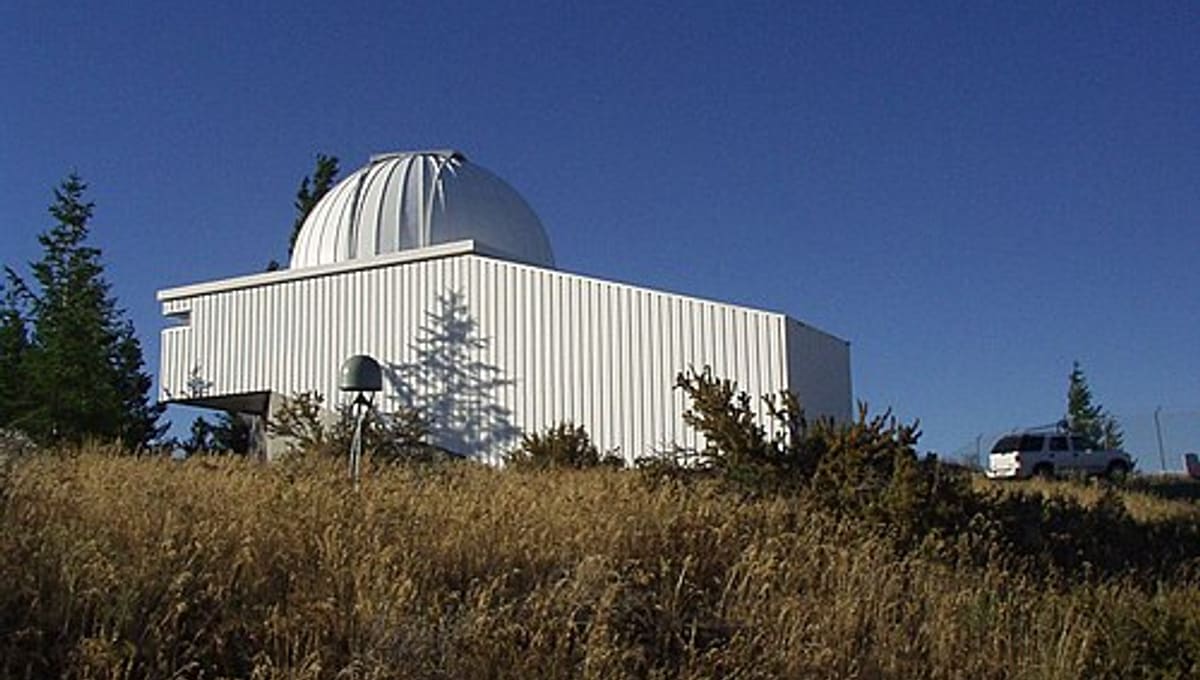
Image: Wikimedia Commons
High in the eastern foothills of Washington State's Cascade Mountains, Manastash Ridge Observatory has served the University of Washington's astronomy programme since 1972.
About Manastash Ridge Observatory
Manastash Ridge Observatory (MRO) sits in a remote spot roughly 14 km west of Ellensburg, Washington, at an elevation of about 1,198 metres (3,930 feet). Built by the University of Washington, it was originally used for professional and graduate research and today serves mainly as a teaching facility for undergraduate students.
History
The observatory was constructed in 1972. Although there was discussion at one point of cutting funding as the university's astronomy department shifted focus to the Apache Point Observatory, MRO continued operating. In 2015 it received a $59,999 grant from the University of Washington's Campus Sustainability Fund, which paid for a 10,000-US-gallon rainwater harvesting system and two solar panels producing over 20,000 kWh a year, cutting the site's water and energy use.
Telescopes & research
The main instrument is a 0.75 m (30 inch) Ritchey-Chrétien telescope built by Boller and Chivens, paired with an Andor thermo-electrically cooled CCD camera. The observatory building also houses the Manastash Ridge Radar, a passive bistatic radar operated by the university's Radar Remote Sensing Laboratory that uses commercial FM broadcasts to study ionospheric turbulence, meteors and aircraft.
Location & getting there
The site is reached via dirt roads from Ellensburg or Selah, Washington, in the eastern foothills of the Cascade Mountains — a remote, dark-sky setting chosen for research and teaching rather than casual visits.
Visiting Manastash Ridge Observatory
As a working University of Washington research and teaching facility on unpaved back roads, MRO is not set up for general public visits; anyone interested in access should contact the university's astronomy department directly.
See your named star from here
MRO's 0.75 m telescope is exactly the kind of instrument that can be pointed at the precise coordinates of a named star. If you've named a star with Star Register, its right ascension and declination are yours to keep — see it alongside others in our star catalogue.
Opening hours and public-visit programs vary by season. Check Google Maps for current times before you travel.
Institutional and reference sources used to verify this guide.
Satellite imagery: Esri, Maxar, Earthstar Geographics

 15 km
15 km
 143 km
 160 km