
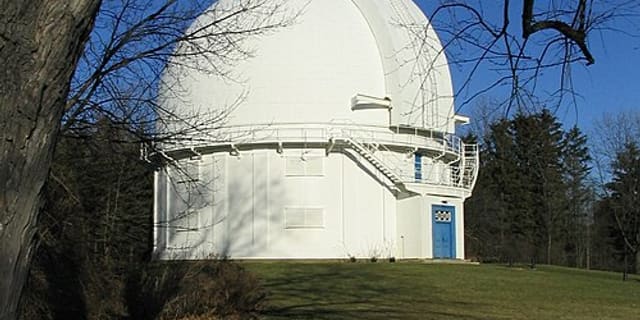
Louis B. Stewart Observatory


Image: Wikimedia Commons
The Louis B. Stewart Observatory, formally known as the Toronto Magnetic and Meteorological Observatory, stands on the St. George campus of the University of Toronto and is regarded as the birthplace of Canadian astronomy.
About Louis B. Stewart Observatory
The original log building was constructed in 1840 as part of a worldwide research project led by Edward Sabine to investigate fluctuations in Earth's magnetic declination. When the international project concluded in 1853, the Canadian government rebuilt the observatory in stone, and it went on to serve as the country's primary meteorological station and official timekeeper for more than fifty years.
History
Measurements taken at the Toronto site provided key evidence that sunspots were responsible for fluctuations in Earth's magnetic field, a significant contribution to 19th-century geomagnetic science. Wikidata records the observatory's founding year as 1855, close to the 1853 stone rebuilding documented in its history.
Location & getting there
The observatory is located on the University of Toronto's St. George campus, in downtown Toronto, Ontario, Canada, in the North America region.
See your named star from here
An observatory that once helped time an entire nation understands the importance of precise coordinates, the same kind you receive with a symbolically named star. Name a star or explore the star catalogue to find your own point in the sky.
Opening hours and public-visit programs vary by season. Check Google Maps for current times before you travel.
Institutional and reference sources used to verify this guide.
Satellite imagery: Esri, Maxar, Earthstar Geographics

 15 kmResearch
 22 km
22 km