
Jacobus Kapteyn Telescope


Image: Wikimedia Commons
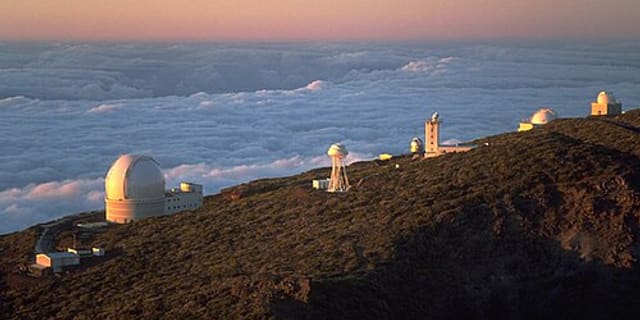
The Jacobus Kapteyn Telescope, or JKT, is a 1-metre optical telescope at the Roque de los Muchachos Observatory on La Palma in Spain's Canary Islands, named for the Dutch astronomer Jacobus Kapteyn (1851–1922).
About Jacobus Kapteyn Telescope
The JKT was part of the Isaac Newton Group of Telescopes and weighs nearly 40 metric tons. Funded jointly by the Netherlands and the United Kingdom, it was planned throughout the 1970s and completed in 1983, with its first photographic plate captured in March 1984.
History
During the telescope's construction in 1983, a Spanish container ship carrying its parts to La Palma was involved in an unusual incident, now known as the Alraigo incident, in which a British Royal Navy Sea Harrier fighter jet made an emergency landing on the base plate intended for the telescope. The JKT was retired as a common-user facility in August 2003 after being superseded by larger, newer telescopes. Since 2014 it has been owned by the Instituto de Astrofísica de Canarias (IAC) and operated by the Southeastern Association for Research in Astronomy (SARA), which retrofitted it as a remotely operated observatory under the internal designation SARA-RM, resuming observations in April 2016.
Telescopes & research
Originally capable of using two different focal points with a range of instruments, the JKT was refined by 1998 to work with a single CCD imaging instrument. In its current SARA-RM configuration, it continues to operate as a remotely controlled research telescope.
Location & getting there
The telescope sits at 2,369 metres elevation at the Roque de los Muchachos Observatory, one of the world's premier astronomical sites, on the volcanic island of La Palma in the Canary Islands, Spain.
Visiting Jacobus Kapteyn Telescope
The Roque de los Muchachos Observatory offers guided visits to parts of its site; check the Isaac Newton Group or IAC's official channels for current tour availability and hours before travelling, as the JKT itself operates remotely and unattended.
See your named star from here
Few sites carry as much astronomical pedigree as Roque de los Muchachos. When you name a star with Star Register, you receive its precise RA/Dec coordinates, ready for a telescope on La Palma to be pointed toward. Browse the star catalogue to find your star.
Opening hours and public-visit programs vary by season. Check the official website and Google Maps for current times before you travel.
Institutional and reference sources used to verify this guide.
Satellite imagery: Esri, Maxar, Earthstar Geographics

 under 1 km
 under 1 km
Nordic Optical Telescope observatory
astronomical observatory complex at Roque de los Muchachos Observatory