
High Energy Stereoscopic System

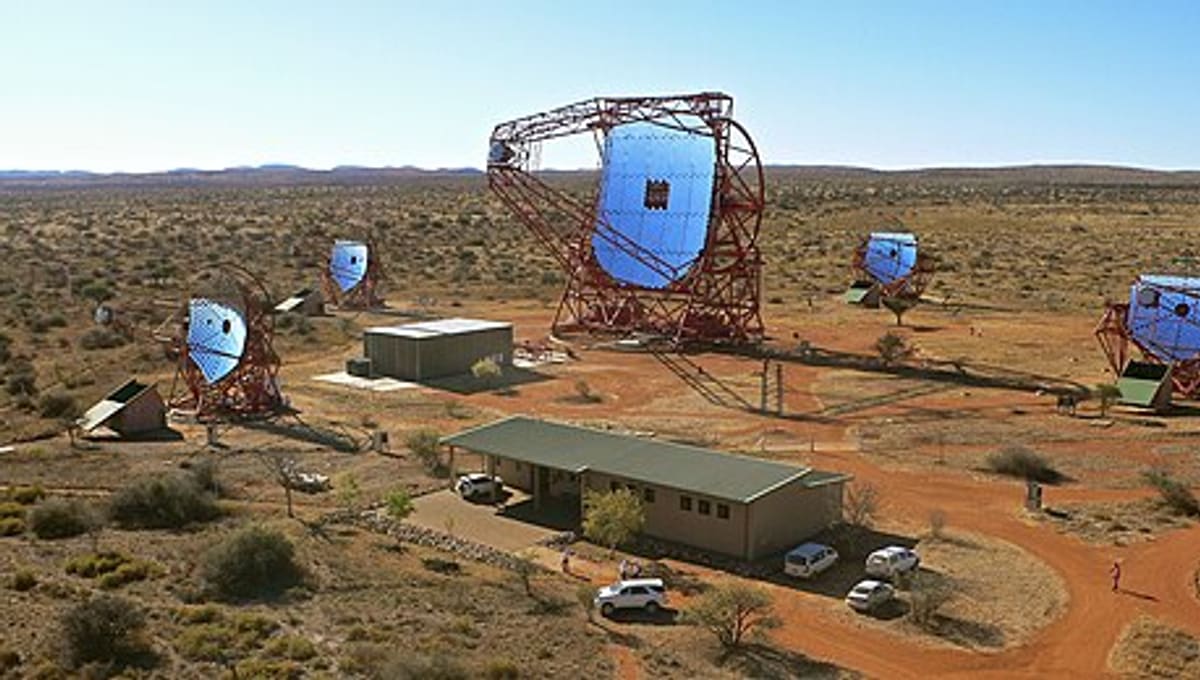
Image: Wikimedia Commons
The High Energy Stereoscopic System, known as H.E.S.S., is an array of gamma-ray telescopes in the Khomas highlands of Namibia, near the Gamsberg mountain.
About High Energy Stereoscopic System
H.E.S.S. has operated since 2002 at an elevation of 1,800 metres, in an area recognised for its excellent optical quality. The name honours physicist Victor Hess, who discovered the extraterrestrial origin of cosmic rays, and also reflects the array's design: several telescopes observing the same air shower from different angles.
History
The first H.E.S.S. telescope began observing in the summer of 2002; all four original telescopes were operational by December 2003, and the array was officially inaugurated on 28 September 2004.
Telescopes & research
The array consists of five imaging atmospheric Cherenkov telescopes: four telescopes with roughly 12-metre mirrors arranged in a 120-metre square, plus a larger 28-metre mirror telescope at the centre. H.E.S.S. detects cosmic gamma rays across an energy range of 0.03 to 100 TeV, studying sources such as supernova remnants, active galactic nuclei and pulsar wind nebulae, and searching for signatures of dark matter and tests of Lorentz invariance.
Location & getting there
H.E.S.S. is in the Africa region, in Namibia, in the Khomas highlands near the Gamsberg mountain, at an elevation of 1,800 metres. This part of Namibia is prized by astronomers for its clear, dry, stable air.
Visiting H.E.S.S. Observatory
As a working scientific facility, H.E.S.S. is not generally open for casual tourism. Check the official website for any current visiting or outreach information before planning a trip.
See your named star from here
H.E.S.S. was built to see gamma rays no eye can detect, but the Namibian sky above it is also famously good for the kind of stargazing anyone can do. If you've named a star with Star Register, this is one of the clearest skies on Earth to try tracing its coordinates. Look up your star in the star catalogue.
Opening hours and public-visit programs vary by season. Check the official website and Google Maps for current times before you travel.
Institutional and reference sources used to verify this guide.
Satellite imagery: Esri, Maxar, Earthstar Geographics

 1,097 km
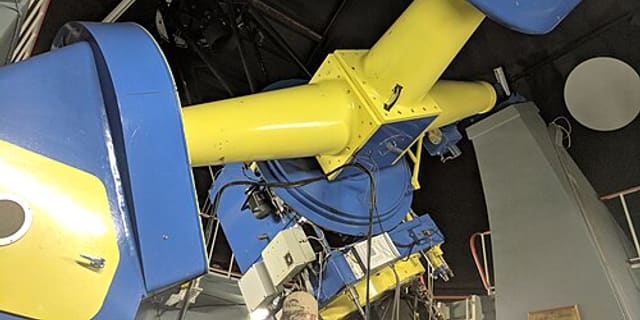
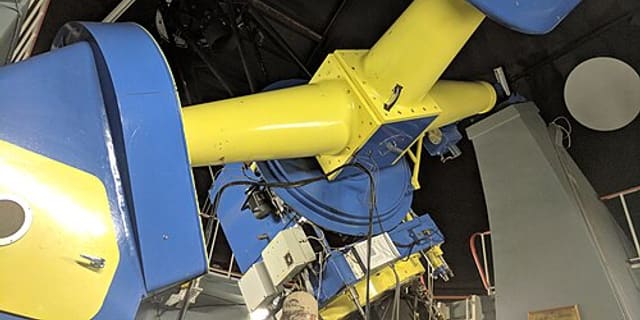
ATLAS–SAAO observatory
astronomical observatory at Sutherland Observatory in South Africa

 1,098 km
 1,098 km