
Georgetown University Astronomical Observatory

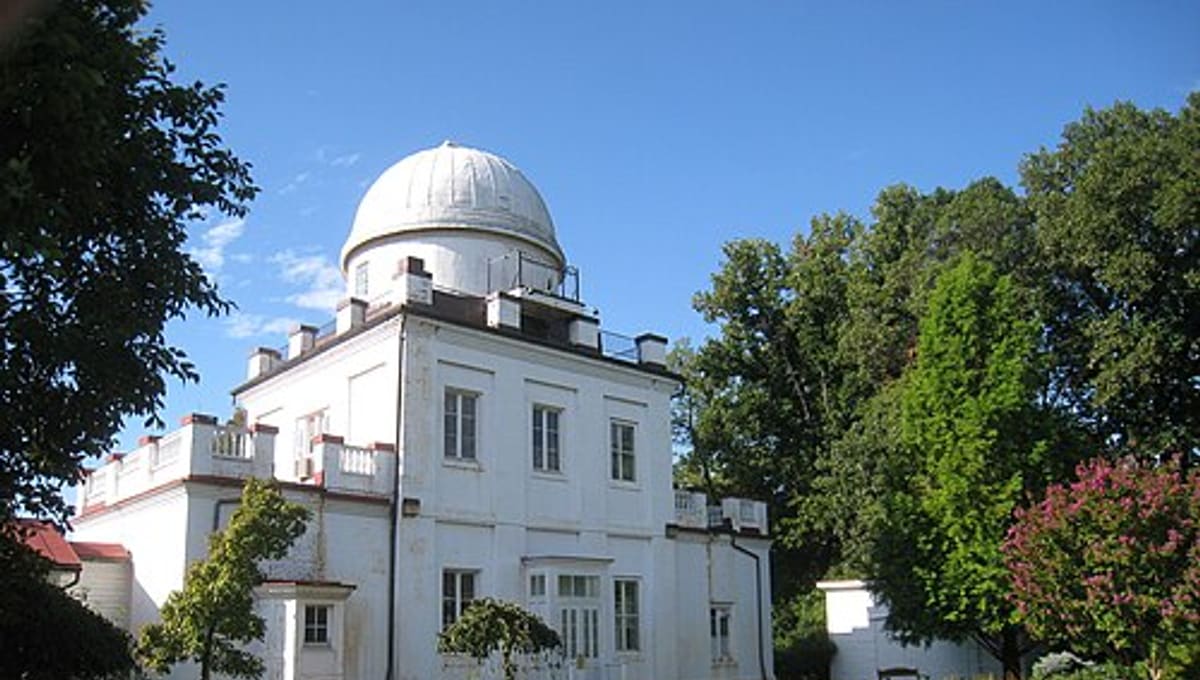
Image: Wikimedia Commons
On a quiet hill on the campus of Georgetown University in Washington, D.C., stands one of the oldest observatories in the United States, founded in 1841 and still watched over by students today.
About Georgetown University Astronomical Observatory
Also known as the Heyden Observatory, it was founded in 1841 by Father James Curley of Georgetown's Department of Physics, who chose the site, planned the building, and oversaw its construction through to completion in 1844. It is the third oldest observatory in the United States and is currently operated and maintained by the Georgetown University Astronomical Society.
History
In 1846 the observatory was used to determine the precise latitude and longitude of Washington, D.C. In 1850, Benedict Sestini used it to produce a celebrated series of sunspot drawings. Johann Georg Hagen, named director in 1888, installed the observatory's 12-inch equatorial telescope, which he used for two decades to study variable stars, and which remains in continuous use today. Later directors included Paul McNally from 1928 and Francis J. Heyden, S.J. from 1945, who researched solar eclipses. The university's Department of Astronomy closed in 1972, and on 2 July 1973 the observatory was designated a National Historic Landmark on the National Register of Historic Places. The surrounding Heyden Memorial Garden, developed from 1989, includes conservation and formal gardens that now serve as a monarch butterfly waystation.
Telescopes & research
The observatory's historic 12-inch equatorial telescope, installed in 1888, has been in continuous use for over 130 years, most notably for two decades of variable star observation under director Johann Georg Hagen. Today light pollution from Washington, D.C. limits deep-sky observation, but the instrument remains a working piece of astronomical history.
Location & getting there
The observatory sits on the Georgetown University campus in Washington, D.C., surrounded by the Heyden Memorial Garden, a mix of native-species plantings, formal gardens and ponds on Observatory Hill.
Visiting Georgetown University Astronomical Observatory
The observatory is maintained by the Georgetown University Astronomical Society, which periodically organises renovation and access. For current public visiting or open-house information, check with the Society or the university before planning a visit.
See your named star from here
Even with the glow of Washington, D.C. nearby, Georgetown's historic telescope can still be pointed toward bright, well-placed stars using their exact coordinates. Name a star of your own, or browse the star catalogue to see stars already named.
Opening hours and public-visit programs vary by season. Check Google Maps for current times before you travel.
Institutional and reference sources used to verify this guide.
Satellite imagery: Esri, Maxar, Earthstar Geographics

 3 km
3 kmMark Slade Remote Observatory
astronomical observatory in Virginia, United States