
European Gravitational Observatory
Satellite imagery: Esri, Maxar, Earthstar Geographics
Near Cascina, just outside Pisa in Italy, the European Gravitational Observatory doesn't point telescopes at the sky at all - it listens for ripples in spacetime itself.
About European Gravitational Observatory
The European Gravitational Observatory (EGO) is a consortium that manages the Virgo interferometer and promotes cooperation in gravitational-wave research across Europe. It was founded on 11 December 2000 by the French CNRS and Italian INFN, and is responsible for the construction, maintenance, operation and upgrades of the Virgo detector.
History
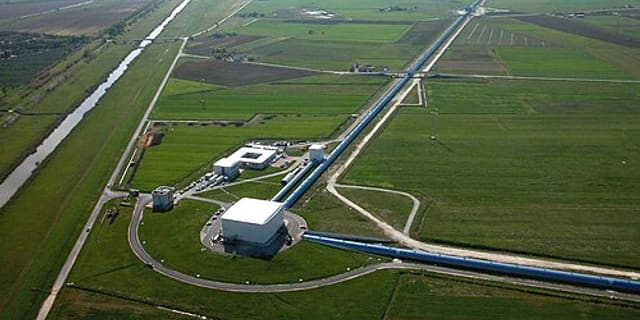
Construction of the Virgo interferometer began in 1996 and was completed in 2003. Virgo is a Michelson interferometer with two perpendicular arms each three kilometres long, designed to detect the minute distortions in space caused by passing gravitational waves, such as those from colliding black holes or neutron stars.
Location & getting there
The observatory is headquartered in Cascina, a town in Tuscany near Pisa in central Italy, chosen for the flat terrain needed for its long interferometer arms.
Visiting European Gravitational Observatory
EGO is a working research facility rather than a public observatory; check its official website for information on visits, open days and educational programmes before planning a trip.
See your named star from here
Gravitational waves and named stars are both about locating something precise in the sky. You can look up the exact coordinates of your named star in the Star Register catalogue, or start a naming through one of our packages.
Opening hours and public-visit programs vary by season. Check the official website and Google Maps for current times before you travel.
Institutional and reference sources used to verify this guide.
Satellite imagery: Esri, Maxar, Earthstar Geographics

 under 1 km