
Virgo

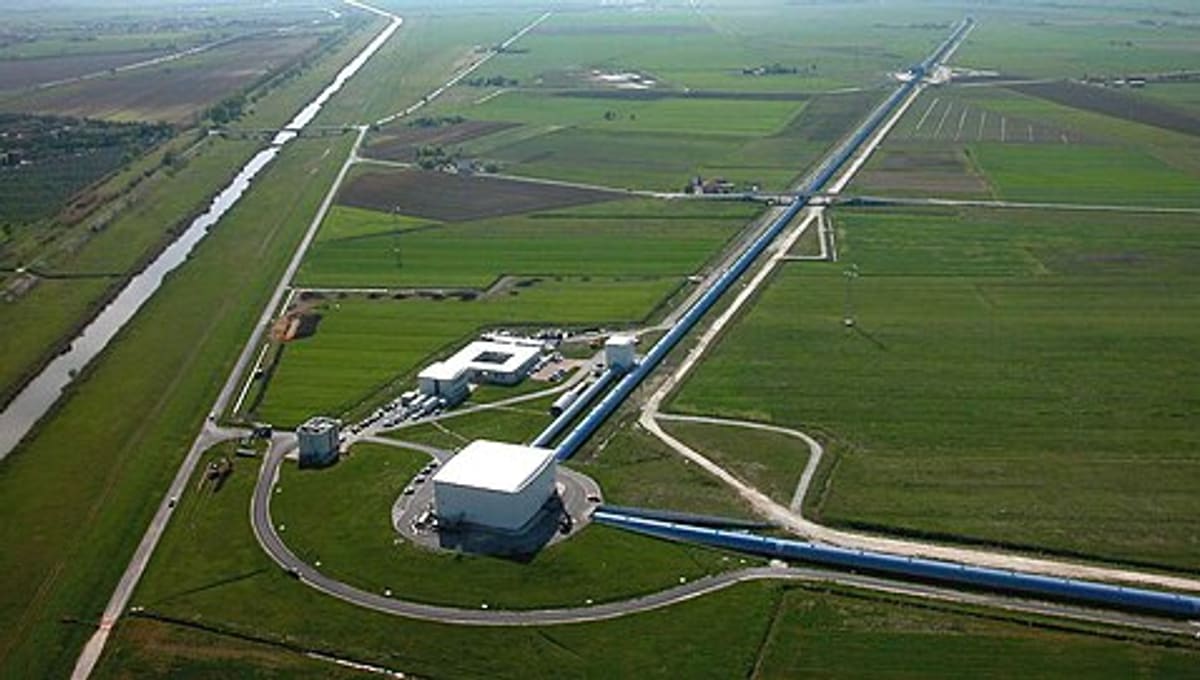
Image: Wikimedia Commons
Near the village of Santo Stefano a Macerata, just outside Pisa in Tuscany, the Virgo interferometer listens for ripples in spacetime rather than light in the sky. It is one of the world's most sensitive gravitational-wave detectors, run as part of an international collaboration searching for signals from colliding black holes and neutron stars.
About Virgo
Virgo is a Michelson interferometer with two arms, each three kilometres long, engineered to detect length changes far smaller than the width of a proton as a gravitational wave passes through. Its mirrors and instrumentation are isolated from the outside world inside an ultra-high vacuum and suspended on complex systems of pendulums, filtering out seismic noise and vibration.
History
The project was approved in 1993, and construction was completed in 2003, after which Virgo began conducting observation runs. It was shut down in 2011 for a major sensitivity upgrade known as Advanced Virgo, resuming observations in August 2017. Weeks later, on 14 August 2017, Virgo made its first gravitational-wave detection alongside the two LIGO observatories in the United States, a collaboration that went on to jointly observe GW170817, the only gravitational-wave event also confirmed with traditional optical, gamma-ray, X-ray and radio telescopes.
Research & collaboration
Virgo is hosted by the European Gravitational Observatory (EGO), a consortium founded by France's CNRS and Italy's INFN. The wider Virgo Collaboration numbers around 940 scientists across 20 countries, and since 2019 has shared data with LIGO and Japan's KAGRA detector as the LIGO-Virgo-KAGRA (LVK) network, coordinating global searches for gravitational waves.
Location & getting there
Virgo sits on flat farmland a short distance from Pisa, in the Tuscany region of Italy, easily reached from the city and its airport.
Visiting Virgo
As an active scientific facility, Virgo is not a conventional stargazing venue, and access is generally limited to organised visits and open days. Check the official website before planning a trip to see whether a tour or event is scheduled.
See your named star from here
Virgo's instruments are tuned to gravitational waves rather than starlight, so you will not view a named star through its interferometer. But a star named through Star Register can be found from anywhere, including on a Tuscan stargazing trip nearby. Browse the catalogue to see how it works.
Opening hours and public-visit programs vary by season. Check the official website and Google Maps for current times before you travel.
Institutional and reference sources used to verify this guide.
Satellite imagery: Esri, Maxar, Earthstar Geographics