
Cerro El Roble Observatory


Image: Wikimedia Commons
Estación Astronómica de Cerro El Roble crowns a 2,185-metre peak some 63 km northwest of Santiago, Chile, and has watched the southern sky since Soviet-Chilean cooperation first equipped it in the late 1960s.
About Cerro El Roble Observatory
Built by the University of Chile in 1967, the observatory is operated by the university's Department of Astronomy within the Faculty of Physical and Mathematical Sciences, and forms part of the National Astronomical Observatory of Chile network. Its main instrument, a 70-centimetre Maksutov telescope known as the AZT-16, was supplied by the Soviet Union and began operations in 1968 — a rare piece of Cold War-era scientific cooperation between the USSR and Chile.
History
The observatory was built in 1967, with the AZT-16 telescope arriving from the Soviet Union and starting science operations the following year, in 1968.
Telescopes & research
Cerro El Roble's work centres on astrometry and supernova hunting. Between 1979 and 1984, a survey led by astronomer José Maza using the site's telescope detected 43 supernovae, a notable haul that helped establish the observatory's reputation in transient astronomy.
Location & getting there
The observatory sits atop Cerro El Roble, roughly 63 km northwest of Santiago, Chile, at an elevation of 2,185 metres, giving it clear, high-altitude skies typical of the country's astronomy sites.
Visiting Cerro El Roble Observatory
As a university research station, Cerro El Roble is not set up for casual tourist visits; anyone wanting to see it should check with the University of Chile's astronomy department for current access arrangements.
See your named star from here
A 70-centimetre research telescope that once tracked 43 supernovae is more than capable of resolving the coordinates of a named star. Search the sky position of your star in our catalogue.
Opening hours and public-visit programs vary by season. Check Google Maps for current times before you travel.
Institutional and reference sources used to verify this guide.
Satellite imagery: Esri, Maxar, Earthstar Geographics

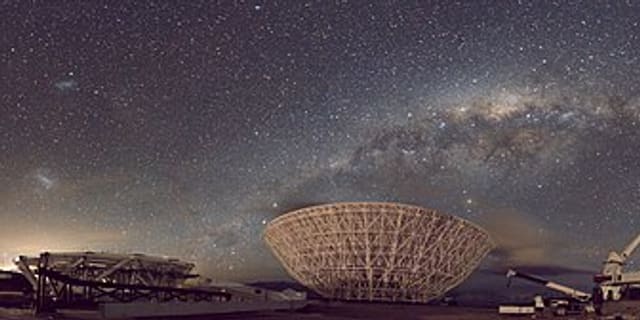 205 km
MASTER-OAFA Observatory
astronomical observatory in San Juan Province, Argentina

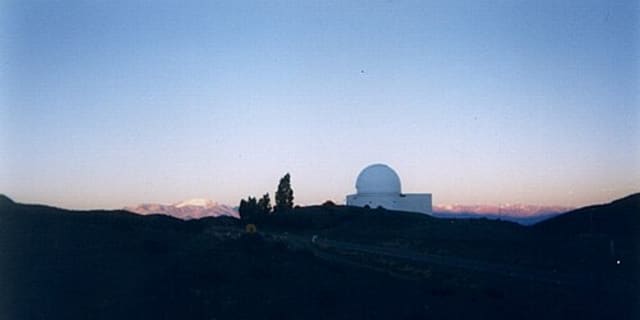 208 km
Alianza S4 observatory
astronomical observatory in San Juan Province, Argentina