
Brooks Astronomical Observatory
Satellite imagery: Esri, Maxar, Earthstar Geographics
Perched on the roof of Brooks Hall at Central Michigan University, the Brooks Astronomical Observatory has been introducing Mount Pleasant, Michigan to the night sky since the 1960s.
About Brooks Astronomical Observatory
Brooks Astronomical Observatory is owned and operated by Central Michigan University. It occupies the roof of the Brooks Hall science building, named for Kendall P. Brooks, who taught astronomy and other subjects at the university from 1910 to 1947.
History
The observatory was established in 1964. Its original 20-inch reflector performed poorly and was replaced in 1977 by a 14-inch Schmidt-Cassegrain, which was in turn replaced in 1996 by the 16-inch computer-controlled Cassegrain reflector, built by DFM Engineering, that the observatory still uses today.
Telescopes & research
The current 16-inch DFM telescope is equipped for CCD direct imaging, medium-dispersion spectroscopy, and visual observation. Professional work carried out at the observatory has included timings of lunar and asteroidal occultations, photometric measurements of variable stars, cluster stars and spectroscopic binaries, and astrometry of minor planets and comets.
Location & getting there
The observatory sits on Central Michigan University's campus in Mount Pleasant, in the north-central Lower Peninsula of Michigan, reached via the upper floors of Brooks Hall.
Visiting Brooks Astronomical Observatory
Monthly public open nights have run since 1976. Sessions are free and open to everyone, held rain or shine - on clear nights visitors look through the 16-inch telescope at the Moon, planets and star clusters, while cloudy nights still offer a tour and Q&A with the hosting astronomer. Reaching the dome involves several flights of stairs above the elevator's third-floor stop. Check Central Michigan University's physics department page for the current open-night schedule.
See your named star from here
A named star from Star Register comes with exact coordinates that any telescope operator, including the volunteers at Brooks Astronomical Observatory's open nights, can use to locate it. Bring your certificate's right ascension and declination along on a visit and ask the hosting astronomer whether it's in view that night. Start with a package at /#packages or browse the catalogue of named stars.
Opening hours and public-visit programs vary by season. Check Google Maps for current times before you travel.
Institutional and reference sources used to verify this guide.
Satellite imagery: Esri, Maxar, Earthstar Geographics

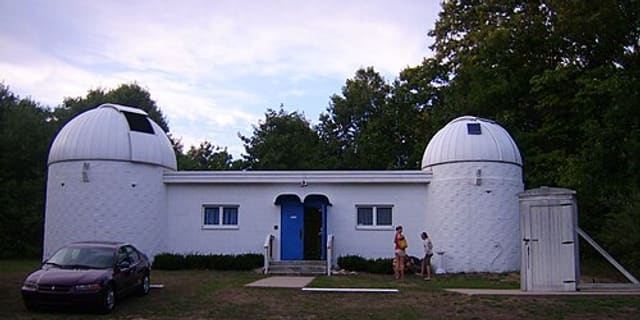 91 km
91 kmKalamazoo observatory
astronomical observatory in Michigan, United States

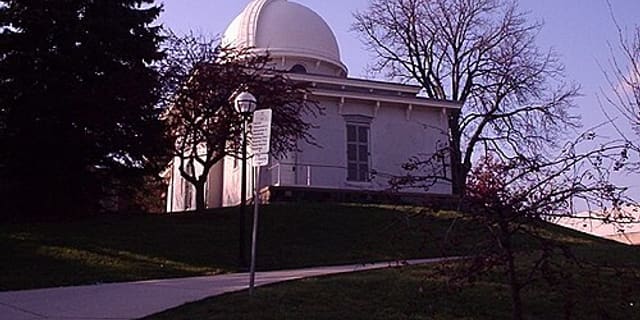 168 km
Detroit Observatory
astronomical observatory in Ann Arbor, United States of America