
Astronomical and Geophysical Observatory in Golovec
Satellite imagery: Esri, Maxar, Earthstar Geographics
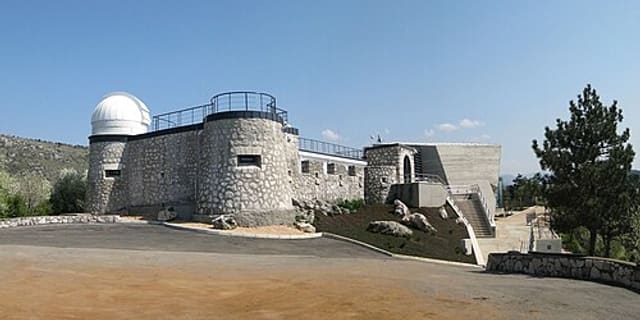
On the wooded slopes of Golovec hill above Ljubljana, Slovenia, the Astronomical and Geophysical Observatory has been a working home for professional and student astronomy since the late 1950s. It remains the research and teaching observatory of the University of Ljubljana's Faculty of Mathematics and Physics.
About the observatory
Sitting at 410 metres elevation, the observatory was the first in Slovenia to establish proper conditions for professional astronomical work. Its 5.5-metre dome, built in 1958, still houses instruments used today for both research and teaching.
History
The observatory was founded between 1954 and 1959 by Professor Fran Dominko, at the initiative of the University of Ljubljana's Faculty of Mathematics and Physics.
Telescopes & research
The observatory's instruments span decades of astronomical technology: a 160mm f/15 Askania Bamberg refractor installed in 1960 for solar observations, a 25cm Schmidt-Cassegrain developed between 1982 and 1990 with a CCD camera, and the 70cm VEGA telescope opened in 2004, once the largest in the country. It has since been replaced by a newly acquired 80cm AZ800 telescope. Research at Golovec focuses on galaxy spectroscopy, galaxy cluster simulations, Lyman-alpha cosmology, and gamma-ray bursts, alongside an active teaching role for students of astronomy, physics, and mathematics running their own observational projects.
Location & getting there
The observatory sits on Golovec hill on the southeastern edge of Ljubljana, Slovenia, within the city's green belt and a short trip from the historic centre.
Visiting the observatory
As a university research facility, access is generally tied to academic programmes and organised events rather than daily walk-in visits. Check the Faculty of Mathematics and Physics website before travelling for any public observation nights or open days.
See your named star from here
With instruments capable of resolving faint galaxies and cosmological signals, a facility like this could, in principle, be pointed at the right ascension and declination of any named star. If you name a star through Star Register, its exact coordinates are yours to keep — browse the catalogue to see how each star's position is recorded.
Opening hours and public-visit programs vary by season. Check the official website and Google Maps for current times before you travel.
Institutional and reference sources used to verify this guide.
Satellite imagery: Esri, Maxar, Earthstar Geographics

 73 km
73 km
 80 km
80 km
 85 kmSolar
 103 km