
Angell Hall Observatory


Image: Wikimedia Commons
Angell Hall Observatory is a rooftop astronomical observatory owned and operated by the University of Michigan, perched atop Angell Hall on the university's Central Campus in Ann Arbor.
About Angell Hall Observatory
The observatory's single dome houses a computer-controlled 0.4-metre Cassegrain telescope, manufactured by DFM Engineering and installed in December 1994, along with a small radio telescope on the roof nearby. Earlier in its history the site held a large clock-driven refracting telescope and a reflecting telescope in side-by-side domes before the current instrument was installed.
History
Angell Hall Observatory is one of several observatories the University of Michigan has operated over the years, a lineage that includes the Detroit Observatory (1854), the Lamont-Hussey Observatory in South Africa (1928), the McMath-Hulbert Observatory at Lake Angelus, Michigan (1930), the Portage Lake Observatory near Dexter (1948), and the Peach Mountain Observatory, also near Dexter (1958).
Telescopes & research
Its current 0.4-metre Cassegrain telescope supports teaching and observation for the university's astronomy department, while the university's historic Detroit Observatory nearby now serves more as a heritage and public-outreach site.
Location & getting there
The observatory sits on top of Angell Hall itself, in the middle of the University of Michigan's Central Campus in Ann Arbor, Michigan, making it easy to find for anyone visiting the campus.
Visiting Angell Hall Observatory
Because it sits on a university building and supports coursework, access is generally tied to university astronomy programmes rather than open public hours. Check with the University of Michigan's astronomy department for any public open nights before visiting.
See your named star from here
A university observatory like this one, with a telescope built for precise, computer-guided pointing, is exactly the kind of place that can be aimed at the coordinates of a named star. If you've dedicated a star through Star Register, you'll find its exact position in the star catalogue to share with observatory staff or your local astronomy society.
Opening hours and public-visit programs vary by season. Check the official website and Google Maps for current times before you travel.
Institutional and reference sources used to verify this guide.
Satellite imagery: Esri, Maxar, Earthstar Geographics

 under 1 km
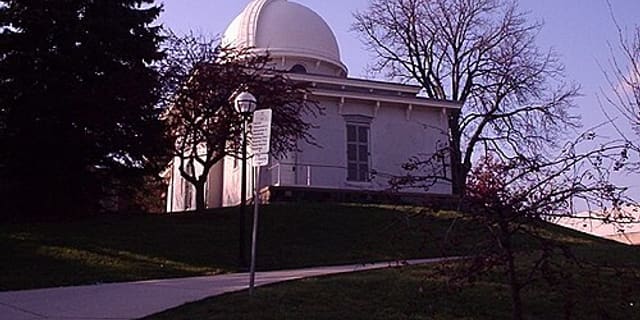
Detroit Observatory
astronomical observatory in Ann Arbor, United States of America

 91 km
91 km
 153 km