
Akeno Giant Air Shower Array
Satellite imagery: Esri, Maxar, Earthstar Geographics
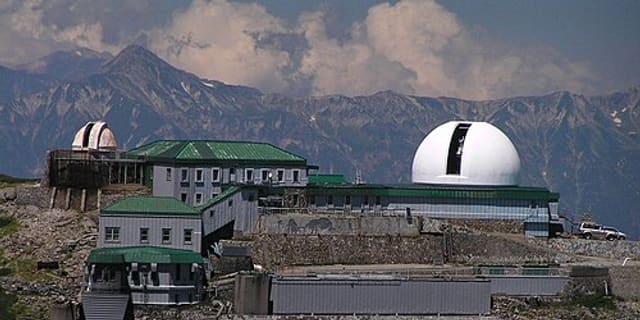
At Akeno Observatory in Yamanashi Prefecture, Japan, the Akeno Giant Air Shower Array once spread more than a hundred particle detectors across the countryside to catch traces of the highest-energy cosmic rays ever measured.
About the Akeno Giant Air Shower Array
Known as AGASA, the array consisted of 111 scintillation detectors and 27 muon detectors spread over roughly 100 square kilometres, operated by the Institute for Cosmic Ray Research (ICRR) at the University of Tokyo. It was designed to study the origin of ultra-high-energy cosmic rays, some of the most energetic particles known to reach Earth.
History
AGASA was deployed between 1987 and 1991 and remained in operation until it was decommissioned in 2004.
Telescopes & research
Akeno Observatory, at roughly 900 metres elevation, continues to be used by ICRR for cosmic-ray and gamma-ray research, including studies of galactic cosmic-ray variation and observations connected to sources such as gamma-ray bursts and active galactic nuclei.
Location & getting there
The site is in the town of Akeno (now part of Hokuto), Yamanashi Prefecture, Japan, in the hills west of Tokyo.
Visiting the Akeno Giant Air Shower Array
This is a specialised scientific research facility rather than a public attraction, and the original AGASA array is no longer in place. If you're interested in the site, check with the Institute for Cosmic Ray Research directly before planning any visit.
See your named star from here
Cosmic-ray research and star naming both depend on precisely knowing where something sits in the sky. Every star in our star catalogue carries the same kind of celestial coordinates that facilities like Akeno use to trace particles back to their origin - if you've named a star, that's the data behind it.
Opening hours and public-visit programs vary by season. Check Google Maps for current times before you travel.
Institutional and reference sources used to verify this guide.
Satellite imagery: Esri, Maxar, Earthstar Geographics

 85 km
85 km
 93 kmRadio