
A.C. Barnes Observatory


Image: Wikimedia Commons
The A.C. Barnes Observatory was a historic astronomical facility on the campus of Cornell University in Ithaca, New York, built in 1903 and no longer standing today.
About A.C. Barnes Observatory
The observatory was funded by Cornell trustee General Alfred C. Barnes, who in the early 1900s offered to pay for a more suitable building to house the university's astronomical and geodetic equipment. It was a handsome brick structure, 80 feet by 20 feet and topped with three domes, equipped with a 5-inch equatorial telescope, two transit telescopes for timing and stellar position work, an astronomical clock, and a dedicated computing room.
History
Completed in September 1903, the Barnes Observatory stood across East Avenue on the site now occupied by Barton Hall. It replaced an earlier, inadequate observatory building, and was itself demolished within a couple of decades to make way for campus development. Cornell's astronomy program then moved to a new building on North Campus, completed in 1917 and named the Fuertes Observatory after Estevan Antonio Fuertes, the professor who built Cornell's first observatory.
Location & getting there
The Barnes Observatory once stood on Cornell's central campus in Ithaca, New York, in the Finger Lakes region, on the site of today's Barton Hall.
Visiting A.C. Barnes Observatory
The original 1903 building no longer exists, so there is nothing to visit on the historic site itself. Cornell's public astronomy tradition continues nearby at Fuertes Observatory, which is generally open to visitors on Friday nights during the academic year - check the Cornell Astronomical Society for current schedules before visiting.
See your named star from here
Cornell's astronomy tradition has run for well over a century, from the original Barnes Observatory to the telescopes at Fuertes Observatory today, both well suited to picking out the exact coordinates of a named star. Name a star or browse the catalogue of named stars.
Opening hours and public-visit programs vary by season. Check Google Maps for current times before you travel.
Institutional and reference sources used to verify this guide.
Satellite imagery: Esri, Maxar, Earthstar Geographics

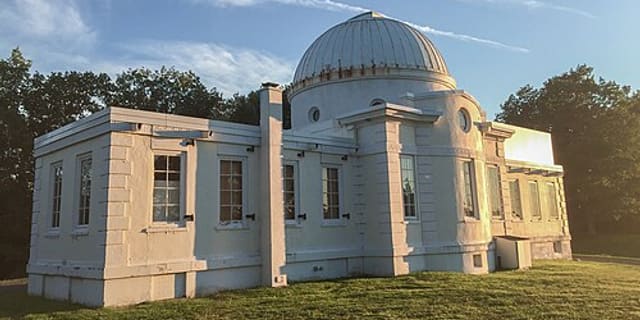 under 1 kmResearch
Fuertes Observatory
historical astronomical observatory at Cornell University, Ithaca, New York

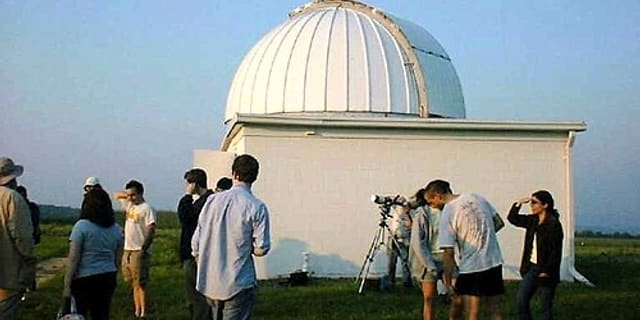 8 km
8 km
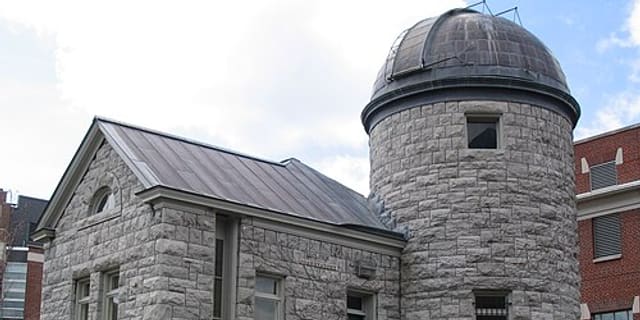 72 kmResearch
Holden Observatory
observatory on Syracuse University campus in Syracuse, New York
C. E. K. Mees Observatory
astronomical observatory at the University of Rochester