
What kind of star is Barnard's Star?
Barnard's Star, catalogued as GJ 699 (HIP 87937), appears in the official constellation Ophiuchus. Its apparent visual magnitude is about 9.54; low-level flare variable, while its estimated distance is 5.96 light-years. Astronomers classify the object as M4 V red dwarf. These labels describe temperature, luminosity class or system components; they should not be read as a claim that every naked-eye point is a single isolated star.
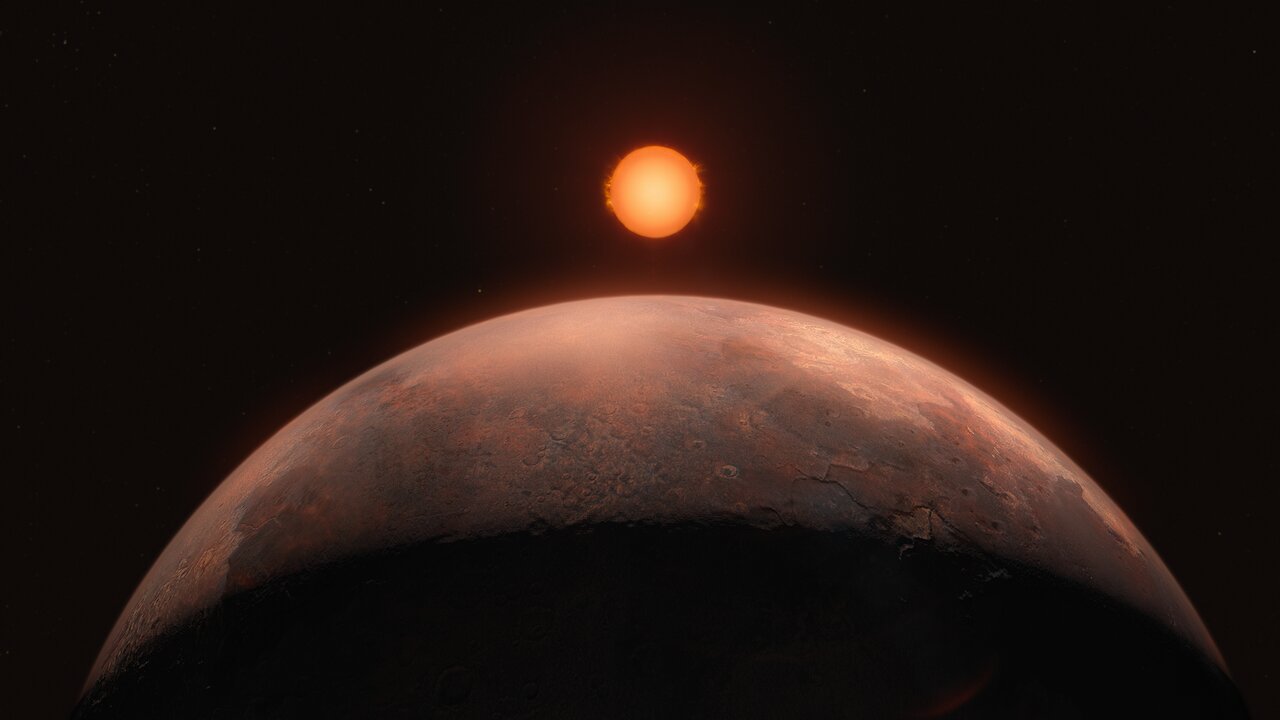
Barnard's Star is an old, low-mass M dwarf only six light-years away. Its proper motion exceeds ten arcseconds per year, a conspicuous angular shift caused by the combination of proximity and high space velocity. Radial-velocity measurements with ESPRESSO and MAROON-X established four sub-Earth-mass planets in a tightly packed system with orbital periods shorter than seven days. All four receive too much stellar energy to lie in the conventional habitable zone. These results supersede the disputed 2018 signal for a much longer-period super-Earth, which newer analyses did not recover. Despite its age and usually quiet appearance, Barnard's Star can flare, an important complication for both photometry and the environments of close-orbiting planets.
The coordinate pair RA 17h 57m 48.50s, Dec +04° 41′ 36.2″ fixes the object's direction on the celestial sphere for the J2000 reference epoch. Right ascension works like celestial longitude measured in hours, while declination works like latitude north or south of the celestial equator. Proper motion and improved measurements can refine catalogue positions, but these coordinates are sufficiently precise for a finder chart or planetarium search.
Barnard's Star data at a glance
| Proper name | Barnard's Star | Catalogue designation | GJ 699 (HIP 87937) |
|---|---|---|---|
| Constellation | Ophiuchus | Apparent magnitude | about 9.54; low-level flare variable |
| Spectral or system type | M4 V red dwarf | Estimated distance | 5.96 light-years |
| Right ascension (J2000) | 17h 57m 48.50s | Declination (J2000) | +04° 41′ 36.2″ |
Values are rounded for an observer-friendly overview. Consult the linked SIMBAD record for component-level identifiers, bibliography, measurement provenance and newer catalogue values.
The name Barnard's Star
Barnard's Star honours American astronomer Edward Emerson Barnard, who measured its exceptional proper motion in 1916. The possessive form distinguishes the named star from the many catalogue entries associated with Barnard's surveys.
E. E. Barnard did not discover the point source itself, but in 1916 he recognized its extraordinarily rapid motion by comparing photographic plates. Peter van de Kamp later claimed astrometric planets, but other observatories traced the apparent wobble to instrumental changes. A 2018 radial-velocity candidate also failed later tests. Confirmations in 2024–2025 finally established a different, compact four-planet system—a valuable case study in why exoplanet claims require independent data.
Modern professional catalogues retain identifiers such as the Bayer designation alongside a proper name. The International Astronomical Union standardizes which name belongs to which component—an important distinction for systems whose combined light looks like one star from Earth.
How to find Barnard's Star
Use a current detailed chart near 66 Ophiuchi and a small telescope under a dark sky. The star looks like an ordinary faint reddish point. Photograph the field in different years with the same scale and orientation to reveal its movement against more distant background stars.
A telescopic target near the celestial equator, observable from almost all inhabited latitudes during local summer. Visibility on a particular night still depends on latitude, season, time, horizon obstructions, weather and local light pollution. Use the interactive atlas below to check the surrounding field before observing.
Observation checklist
- Use a chart corrected for the current epoch.
- A small telescope can reach magnitude 9.5 under a sufficiently dark sky.
- Repeat photographs years apart to record its proper motion.
- None of its planets can be visually separated with amateur equipment.
Interesting facts about Barnard's Star
- It has the greatest measured proper motion of any known star.
- It is the closest single-star system to the Sun.
- Four confirmed sub-Earth planets orbit in less than seven days.
- The famous van de Kamp planet claims were caused by systematic error.
- The separate 2018 long-period planet candidate is not the confirmed 2024–2025 system.
Continue from Barnard's Star into the night sky
Use the Ophiuchus constellation guide to place this star within its larger pattern. When you are ready to observe, compare dark-sky places, find a nearby observatory, or follow our practical guide to finding a star in the night sky. Symbolically registered names are kept separately in the searchable Star-Register catalogue.
Sources and further reading
Measurements are rounded for readability. Multiple systems, variable stars and distant supergiants can have component-specific or model-dependent values. Survey panels show photographic sky fields, not the physical surface of the star.