

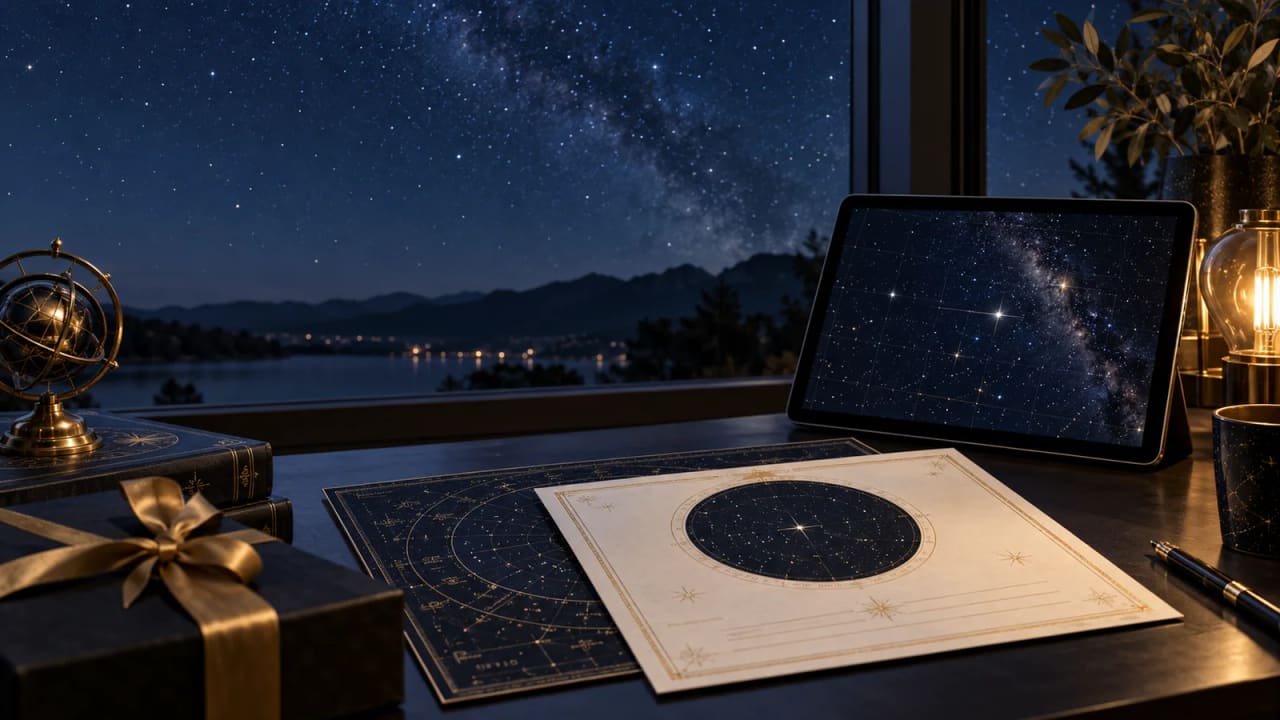
You cannot buy legal ownership of a physical star or purchase an official scientific name. You can buy a symbolic star-naming service: a private provider associates your chosen name with a real star's coordinates, stores that dedication in its own registry and supplies a certificate, map or finding tools. Star naming is legitimate as a commemorative gift when that limited status is explained clearly.
The short answer: a genuine package can connect your dedication to an identifiable star, but it does not transfer property and does not replace the star's catalogue designation. The International Astronomical Union does not sell personal star names, and NASA does not run or approve commercial star registries.
- A private star name and an official astronomical name are different records.
- The assigned object should be a real star with verifiable coordinates and a catalogue ID.
- A certificate documents the provider's dedication; it is not a property deed.
- Separate companies maintain separate registers, so there is no universal commercial database.
- The offer is honest only when its wording, price, delivery and refund terms match what is provided.
Can you actually buy a star?
No person or company can put a physical star into a shopping basket or convey legal title to it. Stars are enormous celestial bodies, usually many light-years away, and a retailer has no ownership interest to transfer. When an advert says "buy a star," it is using convenient gift language for a naming or dedication package.
The distinction is not merely technical. It determines what a buyer can reasonably expect. You are paying for personalisation, administration, certificate design, a private database record, astronomical coordinates, maps, software access and perhaps printing or delivery. You are not paying for mining rights, control of the object, exclusive scientific recognition or the power to stop astronomers using an existing designation.
The 1967 Outer Space Treaty states that outer space and celestial bodies are not subject to national appropriation. That treaty addresses states rather than gift retailers, but it illustrates why an ordinary commercial checkout cannot create recognised ownership of a star. A transparent provider therefore sells a service and keepsake, not celestial real estate.
Is star naming legit?
It can be a legitimate symbolic gift, but it is not an official astronomical naming process. Legitimacy depends on whether the provider describes the product honestly and delivers the promised private record and materials. A certificate tied to a real star can be meaningful; a claim that the buyer has changed NASA or IAU records would be misleading.
| What the offer says | What it can reasonably mean | What it cannot mean |
|---|---|---|
| "Name a real star" | A private dedication linked to the coordinates of a genuine catalogued star | An official scientific name purchased from the IAU |
| "Registered forever" | The provider intends to retain its own registry entry indefinitely | A guarantee that every independent registry or observatory will recognise it |
| "Your star" | Personal or affectionate language used for the gift | Legal ownership of the celestial object |
| "Unique name" | The provider does not duplicate that entry within its database | Worldwide exclusivity across unrelated private registers |
| "Visible star" | The provider supplies a brightness category and finding information | A promise it is visible to every naked eye, from every location, every night |
Think of the service as a personalised record built around astronomy. The star exists independently; the provider supplies the emotional association and the tools for returning to that part of the sky. If both buyer and recipient understand that arrangement, the value can be judged like any other personalised gift.
Who officially names stars?
The International Astronomical Union coordinates the names and designations used by professional astronomy. Its Working Group on Star Names catalogues culturally established proper names, while most stars are identified through catalogue designations such as HIP, HD, TYC, Gaia or 2MASS numbers. Those systems prevent ambiguity across research papers and databases.
The IAU states that commercially purchased names have no formal validity. It does not sell personal naming rights or maintain a commercial alternative. That position is consistent with the American Astronomical Society, which explains that names sold by businesses are not recognised by the scientific community.
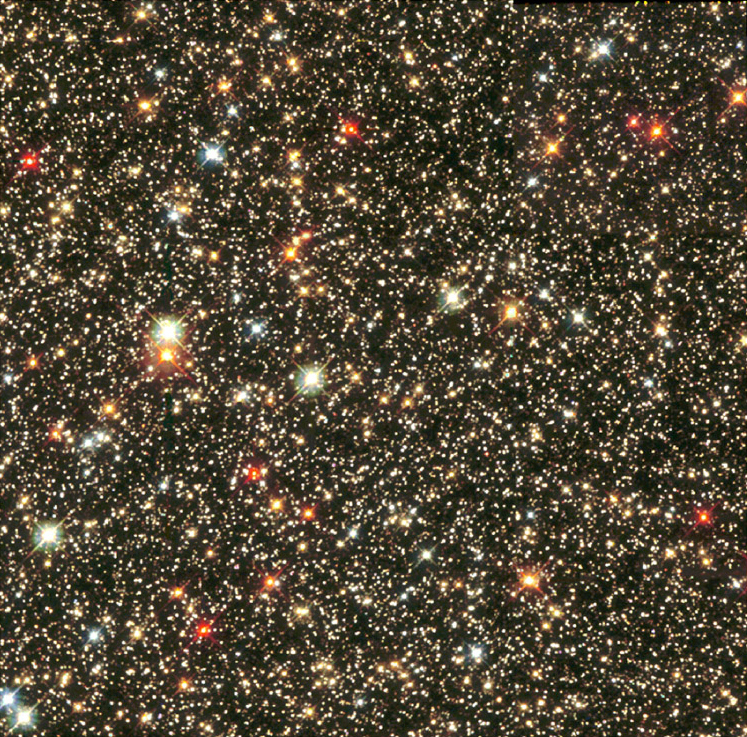
This does not mean only famous stars are real. A faint object with a catalogue number is still a genuine star. It means the private dedication and scientific identifier serve different purposes. A good certificate preserves both: the personal name for the recipient and the catalogue details needed to identify the actual object.
Can you buy or name a star through NASA?
No. NASA conducts and supports space science, missions, observations and public education; it does not sell stars or personal star names. NASA's StarChild educational service explains that a commercial name remains in the files of the company selling it rather than becoming an official scientific name.
Be careful with phrases such as "NASA star," "NASA-approved registration" or "registered with NASA." A provider may legitimately use an object found in a public catalogue assembled with space-telescope data. It may also link to NASA imagery or databases. Neither fact makes NASA the seller, registry operator or endorser.
Our detailed guide to NASA, the IAU and star names explains the agencies and databases separately.
What do you get when you name a star?
Packages vary, but the useful core is the same: a personal dedication plus enough astronomical information to identify the assigned star. Presentation upgrades change how the gift arrives, not the scientific status of the name.
| Package element | Why it matters | What to check |
|---|---|---|
| Personalised certificate | Records the chosen name, date and message | Spelling preview and correction policy |
| Celestial coordinates | Identify the star's position independently of the personal name | Right ascension, declination and reference epoch |
| Scientific catalogue ID | Connects the object to established astronomical data | A recognisable catalogue prefix and number |
| Constellation and map | Provides wider sky landmarks for finding the target | Visibility from the recipient's latitude |
| Private registration number | Retrieves the provider's dedication later | A working online lookup and shareable record |
| Printed presentation | Turns the record into a physical keepsake | Paper, frame, folder, shipping and final price |
Use our star registry lookup to see how a personal name can be displayed alongside coordinates and catalogue data. A provider's own registry number should open its record; the scientific ID or coordinates should help identify the star elsewhere.
How to tell whether a star-naming service is trustworthy
- Read the status statement. It should explain that the dedication is symbolic and private rather than an IAU name or property right.
- Identify the business. Look for a legal operator, contact details, terms, privacy information and a secure checkout.
- Verify the deliverables. The page should specify what is digital, what is printed, and what costs extra.
- Check the astronomy. A real star needs coordinates, constellation information and preferably a recognised catalogue ID.
- Examine visibility wording. Magnitude and observing equipment should support promises about seeing the target.
- Review independent feedback. Read recent positive and negative reviews, not only selected quotes on the seller's site.
- Check corrections and returns. Personalised products may have different cancellation rules, so confirm them before submitting the name.
- Compare the final total. Include taxes, shipping, frames, constellation selection and brightness upgrades.
A useful test: could you describe the purchase to the recipient without using the words "own" or "official"? If the honest description still sounds meaningful—a personal dedication, real coordinates and a keepsake—the product may fit the occasion.
Star registry red flags
Pause before checkout if a site implies endorsement by NASA, the IAU or an observatory without a direct supporting source. Also be cautious when the legal business is difficult to identify, the displayed price changes only after personalisation, the scientific data is missing, or the refund wording excludes nearly every realistic problem.
Other warning signs include countdown timers that continually reset, unsupported claims of worldwide legal ownership, review totals with no link to the underlying platform, and vague promises that the name will appear in ordinary astronomy software. Planetarium apps generally search official names, catalogue IDs or coordinates—not names created in unrelated private databases.
How much does legitimate star naming cost?
Price does not make a name more official. Digital packages commonly start around $10–$50, while printed folders, frames, gift boxes, brighter-star options and international delivery often bring the total to roughly $40–$100 or more. The value difference is usually presentation, service and finding tools.
Compare dated examples and common checkout upgrades in our 2026 star-naming cost guide. The most expensive package is not automatically the best; choose the format the recipient will use and a provider whose claims you understand.
Does a symbolic name still mean something?
Symbolic does not mean imaginary. Wedding vows, memorial plaques and adopted-animal sponsorships also derive value from a personal record rather than ownership. A star dedication can give a relationship or memory a physical certificate and a repeatable ritual: opening a sky map, finding the constellation and returning to it on meaningful dates.
What weakens the gift is not its symbolic nature but a mismatch between promise and reality. Be explicit when you present it: “I dedicated this real star to you in a private registry, and these coordinates show us where to look.” That sentence is both accurate and emotionally clear.
Alternatives to commercial star naming
If official recognition is essential, a paid personal name is not the right product. Consider donating to an astronomical society, planetarium, observatory or research programme in someone's honour. Some institutions offer donor acknowledgements or adopt-a-star fundraisers while clearly retaining the object's scientific designation.
You can also plan a stargazing evening, create a map of the sky for a meaningful date, visit an observatory, or choose a dark location from our stargazing directory. These alternatives can complement a private dedication rather than replace it.
Common questions about buying and naming stars
Is buying a star a scam?
It is misleading if the seller claims to transfer ownership or create an official scientific name. It can be a legitimate personalised service when the symbolic status, private registry, real star data, package contents and price are disclosed accurately.
Will NASA recognise my star name?
No. NASA does not maintain commercial star-name records. Use the scientific catalogue identifier or coordinates when searching professional databases and astronomy tools.
Can an observatory find the star?
An astronomer can use valid coordinates or a recognised catalogue ID to identify the object, subject to its brightness, observing conditions and equipment. The personal name alone is unlikely to appear in the observatory's scientific software.
Can another registry name the same star?
Yes. Private registries are independent. A provider can promise uniqueness only within the database it controls unless it has a documented agreement with another organisation.
Does a copyright registration make the star name official?
No. Copyright can protect the expression or compilation of a published catalogue; it does not grant ownership of the stars or convert entries into scientific names.
What is the safest wording for the gift?
Describe it as a symbolic dedication of a real catalogued star, recorded by the named private registry. Keep the coordinates and catalogue number with the certificate.
Sources and further reading
- International Astronomical Union — Buying Stars and Star Names.
- International Astronomical Union — Astronomy FAQ: Can I buy a star?.
- NASA StarChild — How can I buy a star?.
- American Astronomical Society — Can I buy a star?.
- United Nations Office for Outer Space Affairs — Outer Space Treaty.
- LabelStars — How to name a star after someone, for a commercial provider's description of the symbolic gift process.
Ready to compare the gift itself? See the buy-a-star landing page, learn how to name a star after someone, or follow our practical step-by-step guide.