
Warner Observatory


Image: Wikimedia Commons
Warner Observatory was a pioneering astronomical facility on East Avenue in Rochester, New York, completed in 1882 and famous for putting the public behind the eyepiece of a major research telescope for the very first time.
About Warner Observatory
The observatory was financed by Hulbert Harrington Warner, a Rochester businessman who became patron to the American astronomer Lewis Swift. Its circular tower, built from white sandstone quarried in Lockport, stood about a third of a mile south of the University of Rochester, with what Swift himself described as a nearly unobstructed horizon over woodland, field and meadow.
History
Warner spared little expense: by the time the telescope was installed, the project had cost him almost $100,000. Swift used the observatory to search for comets and nebulae, discovering the periodic comet later named 11P/Tempel-Swift-LINEAR among other objects. On Tuesday and Friday evenings he opened the doors to anyone who bought a 25-cent ticket at Warner's Patent Medicine Store, making Warner Observatory the first observatory in history to welcome paying members of the public. After Warner was forced into bankruptcy in 1893, Swift relocated the telescope to a new observatory his patron Thaddeus S. C. Lowe was building on Echo Mountain in California, partly because Rochester's growing city lights were already crowding out the night sky. The vacant building later served as the Vernon Academy of Mental Sciences and the Vernon Sanatorium between 1901 and 1909, before being boarded up in 1920 and finally razed in 1931.
Telescopes & research
The observatory's centrepiece was a 16-inch refractor made by Alvan Clark and Sons, the fourth-largest telescope in the United States at the time of its installation. Lewis Swift used it for years of dedicated comet and nebula hunting before the instrument moved west with him in the 1890s.
Location & getting there
The original site sat on East Avenue, once described as one of Rochester's most fashionable streets, in what is now western New York State. No trace of the building remains today, so there is no observatory structure to navigate to at these coordinates.
Visiting Warner Observatory
Because the building was demolished in 1931, there is no facility here to tour. Anyone researching Rochester's astronomical history is best served by the University of Rochester and local historical archives; check ahead with any institution before travelling, since opening hours and public access for astronomy-related sites change over time.
See your named star from here
Warner Observatory's own telescope is long gone, but the idea it pioneered, letting ordinary people look up and connect with a specific point in the sky, is exactly what a symbolic star naming continues today. Every named star comes with real coordinates that any telescope, anywhere, can be pointed at. Explore the naming packages or browse the star catalogue to find a star of your own.
Opening hours and public-visit programs vary by season. Check Google Maps for current times before you travel.
Institutional and reference sources used to verify this guide.
Satellite imagery: Esri, Maxar, Earthstar Geographics
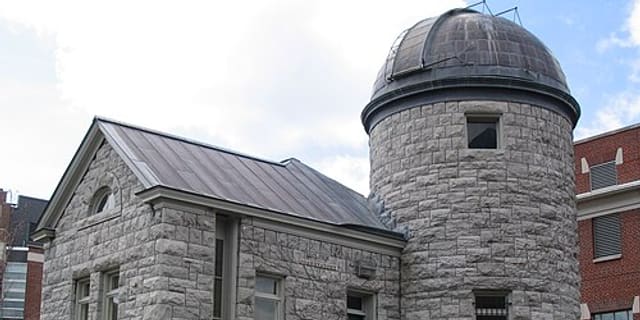
C. E. K. Mees Observatory
astronomical observatory at the University of Rochester

 119 kmResearch
Holden Observatory
observatory on Syracuse University campus in Syracuse, New York

 120 kmResearch
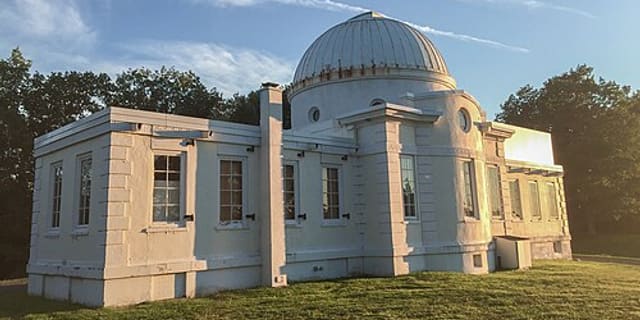
Fuertes Observatory
historical astronomical observatory at Cornell University, Ithaca, New York