
University of Minnesota observatory
Satellite imagery: Esri, Maxar, Earthstar Geographics
The University of Minnesota's astronomy programme is anchored by two very different observatories: a historic downtown dome dating to the 19th century, and a dark-sky outpost built for research decades later.
About University of Minnesota observatory
The university's original observatory near the Mississippi River was first built in 1891 with a transit circle instrument, joined in 1896 by a domed observatory housing a 10.5-inch refractor made by Warner and Swasey. In the 1930s the telescope was moved to the roof of the Physics Building, now Tate Hall, where the historic 10.5-inch refractor still sits in the Tate 510 dome today.
History
To get away from the growing light pollution of the Minneapolis campus, the university later established the O'Brien Observatory in Marine on St. Croix, Minnesota, roughly 35 kilometres northeast of Minneapolis, in 1968.
Telescopes & research
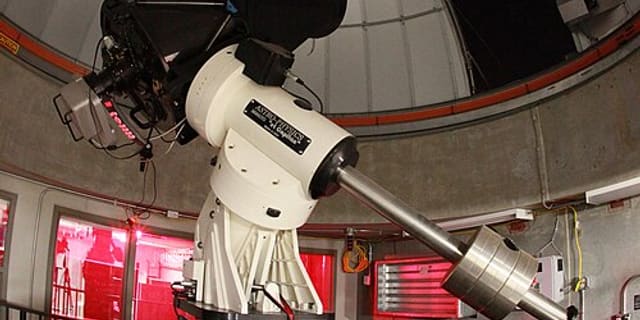
O'Brien Observatory houses a 0.76-metre (30-inch) Cassegrain reflector capable of both optical and infrared observation. Built under astronomer Edward Ney, it was one of the first infrared observatories of its kind.
Location & getting there
The historic 10.5-inch refractor remains on the Minneapolis campus in the Tate Hall dome, while O'Brien Observatory sits in the more rural, darker skies of Marine on St. Croix, about 35 kilometres away.
Visiting University of Minnesota observatory
Public viewing at O'Brien Observatory is held on Fridays during the Fall and Spring semesters. Check the university's astronomy programme website for current schedules before visiting either site.
See your named star from here
Whether from the historic dome on campus or the dark skies of O'Brien Observatory, a named star's coordinates can be found and viewed. Choose your own star from our packages or browse the full catalogue.
Opening hours and public-visit programs vary by season. Check Google Maps for current times before you travel.
Institutional and reference sources used to verify this guide.
Satellite imagery: Esri, Maxar, Earthstar Geographics

 75 km
75 km