
Stratospheric Observatory for Infrared Astronomy

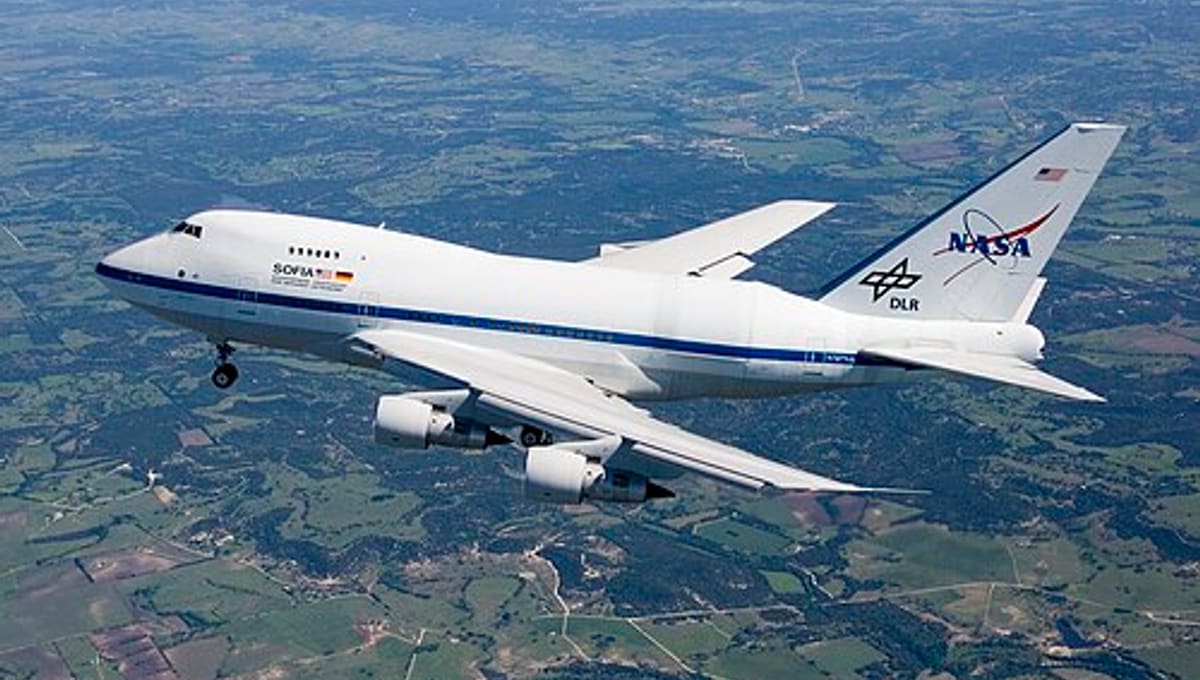
Image: Wikimedia Commons
The Stratospheric Observatory for Infrared Astronomy, known as SOFIA, was a one-of-a-kind flying observatory: a modified Boeing 747 that carried a working telescope into the stratosphere for infrared astronomy.
About the Stratospheric Observatory for Infrared Astronomy
SOFIA was a joint project of NASA and the German Aerospace Center (DLR), split roughly 80/20 between the two agencies. NASA contracted the Universities Space Research Association (USRA) to develop the aircraft and run the American side of the mission, while the German SOFIA Institute (Deutsches SOFIA Institut) managed the German science and telescope work.
History
SOFIA's telescope saw first light on 26 May 2010, continuing the legacy of NASA's earlier Kuiper Airborne Observatory. Over more than a decade of operation, its modified Boeing 747SP flew overnight missions lasting around ten hours, carrying its telescope above most of the water vapour in Earth's atmosphere that blocks infrared light from reaching ground-based observatories. The programme's final flight, its 921st, landed in the early morning of 29 September 2022, bringing the science mission to a close. The aircraft itself has since been preserved and put on public display at the Pima Air & Space Museum near Tucson, Arizona.
Telescopes & research
During its overnight flights, SOFIA's telescope studied celestial magnetic fields, star-forming regions, comets, nebulae and the centre of the Milky Way, work that ground-based infrared telescopes struggle to do because of atmospheric water vapour. Flying above nearly all of that interference let SOFIA observe wavelengths of light that are otherwise very difficult to capture from the ground.
Location & getting there
SOFIA operated out of facilities in California, flying its overnight missions from there before returning to base. It's no longer an active flying observatory, so there's no observing site to visit in the way there is for a ground-based facility.
Visiting the Stratospheric Observatory for Infrared Astronomy
SOFIA's science flights ended in 2022, and the aircraft that carried its telescope is now a museum exhibit at the Pima Air & Space Museum near Tucson, Arizona, where visitors can see the plane that once flew astronomers into the stratosphere.
See your named star from here
SOFIA's flying days are over, but the idea behind it, that a telescope pointed at the right coordinates can reveal what's really out there, is exactly how a named star works too. Every star named through Star Register comes with its own coordinates to find and view. Name a star, or explore the catalogue of stars named so far.
Opening hours and public-visit programs vary by season. Check the official website and Google Maps for current times before you travel.
Institutional and reference sources used to verify this guide.
Satellite imagery: Esri, Maxar, Earthstar Geographics

 35 km
35 km
 43 km
43 kmMount Wilson Observatory
astronomical observatory in Los Angeles County, California

 59 km
59 km