
Stonehenge Aotearoa

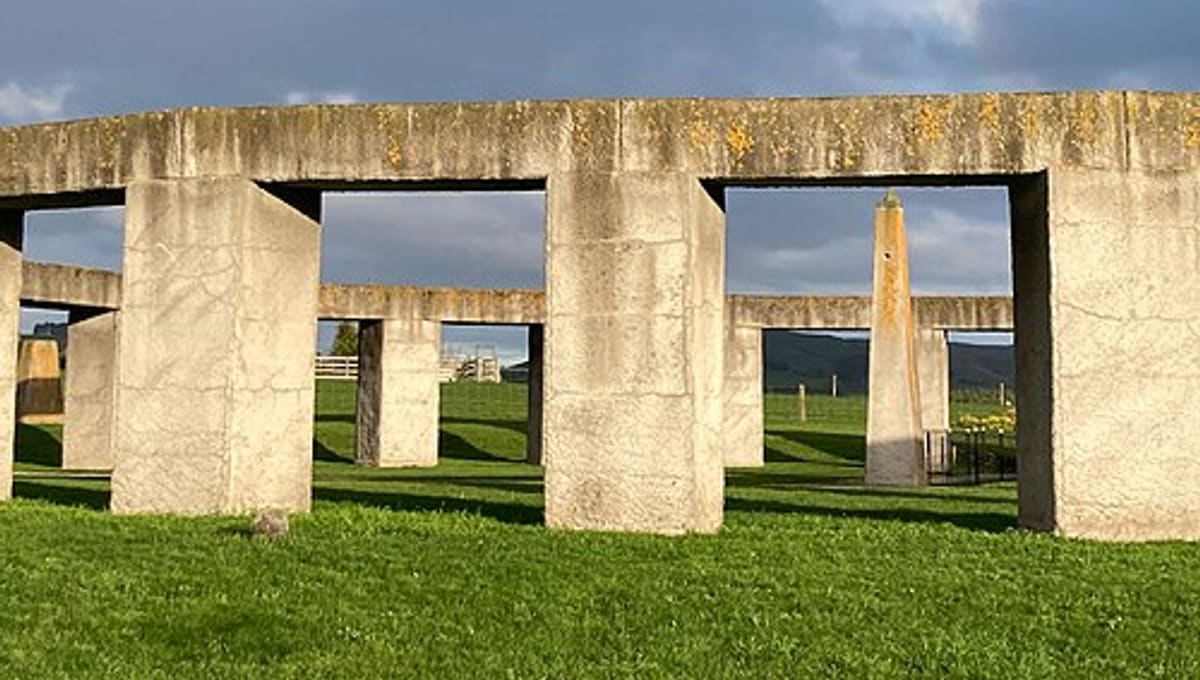
Image: Wikimedia Commons
In the Wairarapa region of New Zealand's North Island, a modern circle of standing pillars called Stonehenge Aotearoa serves as both a work of public art and a fully functioning open-sky observatory.
About Stonehenge Aotearoa
Inspired by England's Stonehenge and built on a similar scale, Stonehenge Aotearoa is made up of 24 pillars of wood and cement board, sculpted and finished to resemble hewn stone, forming a circle 30 metres across and about 4 metres high. A 5-metre obelisk stands near the centre, with a 10-metre analemma marked out along the meridian, and six outer heel stones of varying heights stand beyond the main circle.
History
The site traces back to the mid-1990s closure of the US Naval Observatory's Black Birch station, whose dome and other equipment were transferred to New Zealand astronomer Gordon Hudson and the newly formed Phoenix Astronomical Society (TPAS). With government funding administered through the Royal Society of New Zealand's Science & Technology Promotion Fund, and roughly 150 volunteers from TPAS, the henge was built over two years and opened on 12 February 2005 by Nobel Laureate Professor Alan MacDiarmid.
Telescopes & research
Rather than a conventional telescope building, Stonehenge Aotearoa is designed to demonstrate how ancient peoples tracked the sky using architecture: its non-equidistant pillars are aligned to frame the rising points of the Sun, Moon, and important seasonal and navigational stars, including reference to the Polynesian star compass tradition.
Location & getting there
Stonehenge Aotearoa stands in the Wairarapa region of New Zealand's North Island, a rural area known for clear, dark skies.
Visiting Stonehenge Aotearoa
The site operates as a public educational facility with guided visits; check the official website for current opening hours and tour details before travelling.
See your named star from here
Just as the henge's pillars were positioned to frame specific stars on the horizon, a telescope here could be aimed at the exact right ascension and declination on your own star certificate. Browse the full star catalogue to find your star.
Opening hours and public-visit programs vary by season. Check Google Maps for current times before you travel.
Institutional and reference sources used to verify this guide.
Satellite imagery: Esri, Maxar, Earthstar Geographics

 22 km
22 km
 71 km
71 km
 190 km