
Smeetoren

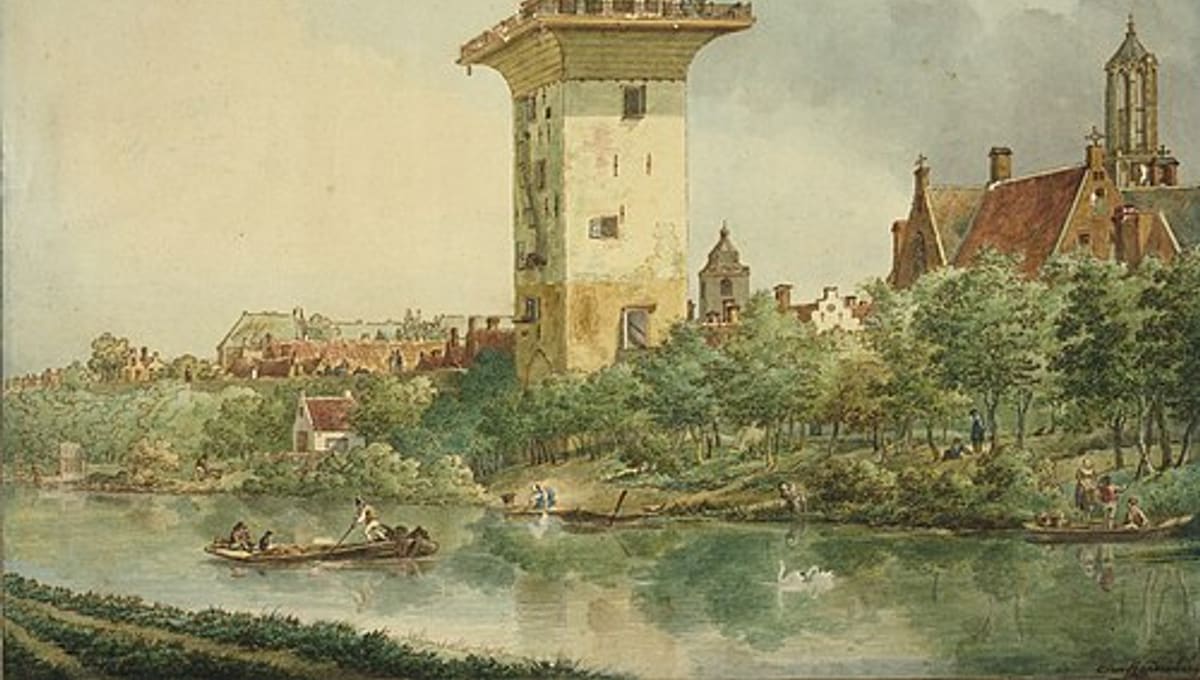
Image: Wikimedia Commons
The Smeetoren was a medieval rampart tower in Utrecht, the Netherlands, that spent two centuries serving as one of the city's astronomical observation points before it was demolished in the 19th century.
About the Smeetoren
Built in 1145 as part of Utrecht's city defences, the tower's original stone spire was replaced in 1642 with a dome and an extended upper section built specifically for astronomical observation, turning a defensive structure into a working observatory for Utrecht University, founded in 1636.
History
Between 1725 and 1740, the researcher Petrus van Musschenbroek carried out meteorological observations from the tower. Astronomical work eventually moved to the nearby Sonnenborgh bastion in 1853, and the Smeetoren itself was demolished in 1854; today, the outline of its former foundations is marked in the street pavement on the site.
Location & getting there
The former tower stood in the city of Utrecht, in the central Netherlands. Its site can still be visited today, marked at street level, and is a short walk from Utrecht's historic centre - use the map and directions on this page to find it.
Visiting the Smeetoren site
Since the tower no longer stands, there is no observatory building to tour; visitors can see the marked outline of its foundations in the pavement, and nearby Sonnenborgh, which inherited its astronomical role in 1853, remains open as a working observatory and museum.
See your named star from here
Utrecht's astronomical tradition continues at Sonnenborgh, where a telescope can be pointed at the precise coordinates of any star - including one named through Star Register. Find a named star's coordinates in the star catalogue.
Opening hours and public-visit programs vary by season. Check Google Maps for current times before you travel.
Institutional and reference sources used to verify this guide.
Satellite imagery: Esri, Maxar, Earthstar Geographics

 46 km
46 km
 49 km
49 km
 60 kmPublic