
Sinnott Memorial Observation Station

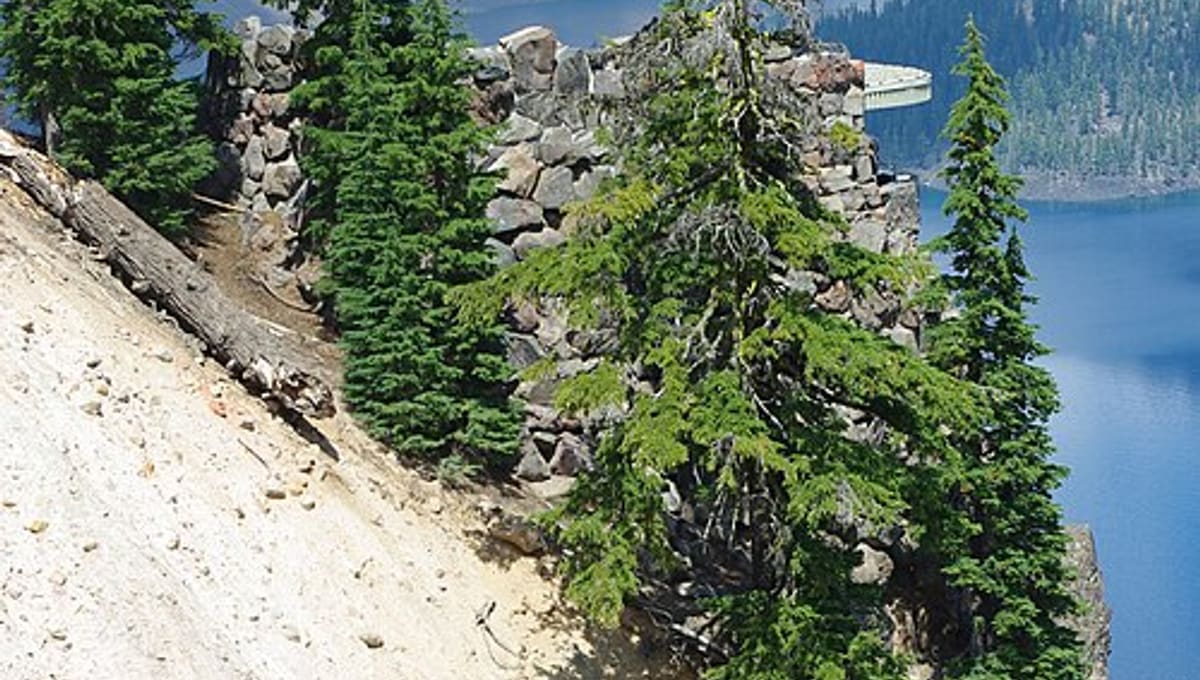
Image: Wikimedia Commons
Built into the caldera cliff 900 feet above the water, the Sinnott Memorial Observation Station offers one of the most dramatic vantage points over Crater Lake in southern Oregon. Despite its name, it's less a stargazing observatory and more a historic overlook and small museum dedicated to the lake's dramatic geologic past.
About Sinnott Memorial Observation Station
The station is a sheltered viewpoint near the Rim Village Visitor Center in Crater Lake National Park, combining a scenic overlook with a small natural history museum. Its exhibits explain the geologic story of Mount Mazama, the ancient volcano whose collapse formed Crater Lake.
History
Construction began in the fall of 1930 and the building was officially dedicated on July 16, 1931, as the Nicholas J. Sinnott Memorial Observation Station and Museum, honoring the U.S. congressman. It holds real architectural significance: it was the first National Park Service building constructed specifically as a museum, and the first structure in Crater Lake National Park built using rustic stone masonry. The station is listed on the National Register of Historic Places.
Location & getting there
At roughly 6,650 feet elevation, the station sits directly on the caldera rim near Rim Village in Crater Lake National Park, Oregon, making it one of the easiest close-up views of the lake for visitors arriving by car.
Visiting Sinnott Memorial Observation Station
The overlook and museum are part of the National Park Service's Rim Village area; check the Crater Lake National Park website or ask at the visitor center for current hours, as access can vary seasonally, particularly in winter.
See your named star from here
Crater Lake's clear mountain air and famously dark skies make it a wonderful place to look up. Name a star to receive its precise coordinates, then check the catalogue of previously named stars - any observatory with a telescope can be aimed at those coordinates on a clear night.
Opening hours and public-visit programs vary by season. Check Google Maps for current times before you travel.
Institutional and reference sources used to verify this guide.
Satellite imagery: Esri, Maxar, Earthstar Geographics

 138 km
Jack C. Davis Observatory
astronomical observatory in Nevada, United States

 472 km