
Sandlot observatory
Satellite imagery: Esri, Maxar, Earthstar Geographics
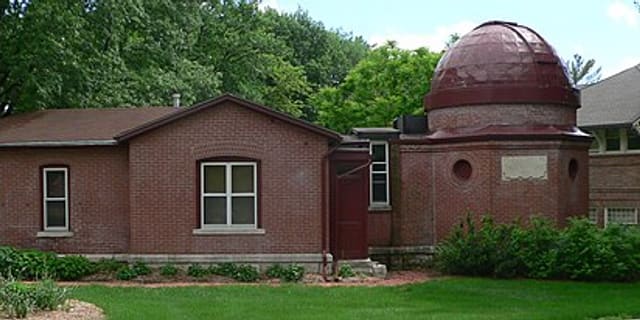
Tucked outside Scranton, Kansas, Sandlot Observatory is a working amateur research station that has spent decades tracking asteroids and near-Earth objects from its own backyard-built dome.
About Sandlot Observatory
Sandlot Observatory is run by astronomers Gary Hug and Graham E. Bell, who built the station, Minor Planet Center code H36, into one of the more productive amateur asteroid-tracking sites in the United States. The observatory's work focuses squarely on discovering and monitoring near-Earth objects.
Telescopes & research
The main instrument is a 22-inch reflector telescope paired with an SBIG STL 6303E camera, a 6.3-megapixel CCD sensitive enough to record objects down to roughly 22nd magnitude after 25 to 30 minutes of exposure under clear skies. Gary Hug used the site to co-discover comet 178P/Hug-Bell, and the observatory's near-Earth object work earned the Planetary Society's Gene Shoemaker NEO Grant in both 2009 and 2018.
Location & getting there
The observatory sits near Scranton in eastern Kansas, part of the wider North American plains where flat horizons and rural darkness give amateur astronomers unusually long, uninterrupted views of the sky.
Visiting Sandlot Observatory
Sandlot Observatory is a working research station rather than a public visitor attraction, so there are no advertised opening hours. If you're interested in its asteroid-tracking work, check astronomy community listings or reach out directly before visiting.
See your named star from here
A research telescope like the one at Sandlot Observatory can be aimed at any set of coordinates, including those of a star named through Star Register. Browse the star catalogue to find a star of your own.
Opening hours and public-visit programs vary by season. Check Google Maps for current times before you travel.
Institutional and reference sources used to verify this guide.
Satellite imagery: Esri, Maxar, Earthstar Geographics
PSU Greenbush Observatory
astronomical observatory in Kansas, United States

 229 km