
San Fernando Magnetic Observatory
Satellite imagery: Esri, Maxar, Earthstar Geographics
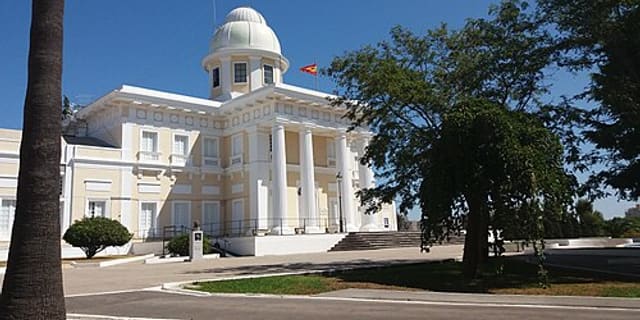
San Fernando Magnetic Observatory is part of the Royal Institute and Naval Observatory (Real Instituto y Observatorio de la Armada) in San Fernando, near Cadiz in southern Spain — one of the oldest continuously operating scientific institutions in the world.
About San Fernando Magnetic Observatory
Founded in 1753 by the Spanish naval officer and scientist Jorge Juan, the institute has grown into one of the country's most important scientific centres, home to a library holding more than 30,000 volumes. Today it also sets the official standard time for Spain.
History
The observatory's geophysics section has been functioning continuously since 1879. Regular geomagnetic measurements began in 1877, with continuous recording underway from 1891 — making San Fernando the only Spanish observatory with an unbroken geomagnetic record stretching back well over a century.
Telescopes & research
Alongside its historical astronomical work, the site's geophysics section specialises in geomagnetism, monitoring the Earth's magnetic field from a fixed reference point on the Iberian Peninsula — work that has made it a long-standing contributor to Spain's national scientific record.
Location & getting there
The observatory sits in San Fernando, in the province of Cadiz, Andalusia, in southern Spain, within our Europe region listing. The town is a short drive from Cadiz itself, on Spain's Atlantic coast.
Visiting San Fernando Magnetic Observatory
The Royal Institute and Naval Observatory is recognised as a cultural and tourism landmark in San Fernando; check the official website or local Andalusian tourism listings for current opening hours and any guided tour arrangements before visiting.
See your named star from here
An institution built on precise measurement — of time and of the Earth's magnetic field — is a fitting place to think about the precise coordinates behind a named star. Every star named through Star Register comes with its own right ascension and declination. Browse the catalogue or name a star to get yours.
Opening hours and public-visit programs vary by season. Check Google Maps for current times before you travel.
Institutional and reference sources used to verify this guide.
Satellite imagery: Esri, Maxar, Earthstar Geographics

 33 kmResearch
Real Instituto y Observatorio de la Armada
astronomical observatory of the Spanish Navy

 308 km