
LOFAR

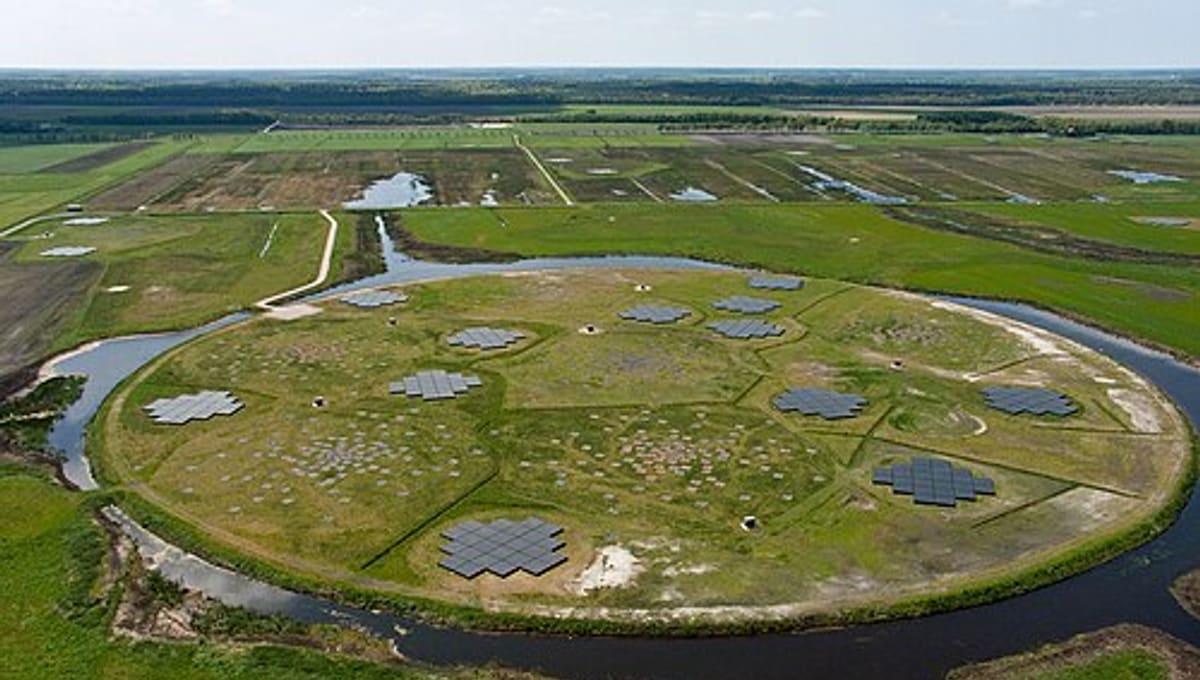
Image: Wikimedia Commons
LOFAR, the Low-Frequency Array, is a vast radio telescope network centred in the Netherlands and reaching across seven other European countries, turning ordinary fields into one of the world's most sensitive low-frequency observing instruments.
About LOFAR
Rather than a single dish, LOFAR is an interferometric array of roughly 20,000 simple antennas grouped into 52 stations. Thirty-eight of these stations are spread across the Netherlands, with the remaining international stations in Germany, Poland, France, Great Britain, Ireland, Latvia and Sweden. Signals from every station are combined over fibre-optic links and processed centrally, giving the network a resolving power equivalent to the distance between its most far-flung antennas.
History
LOFAR was designed and built by ASTRON, the Netherlands Institute for Radio Astronomy, and formally opened by Queen Beatrix of the Netherlands on 12 June 2010. It has since been run on behalf of the International LOFAR Telescope partnership and, more recently, the LOFAR ERIC consortium.
Telescopes & research
LOFAR observes at low radio frequencies between 10 and 240 MHz, an underexplored part of the spectrum. Since 2014 its data have been processed by a GPU-based correlator and beamformer called COBALT, replacing an earlier Blue Gene/P supercomputer, and the archive built from its surveys now holds tens of petabytes of astronomical data. The array also serves as a technology pathfinder for the future Square Kilometre Array.
Location & getting there
LOFAR's stations are concentrated in the Netherlands, forming the hub of a much larger European array. The site's character comes as much from its fibre-optic connectivity linking dozens of stations as from any single dramatic setting. Use the map on this page for its exact coordinates.
Visiting LOFAR
LOFAR is primarily a research facility rather than a public viewing site, and opening hours are not listed in our records. Check the official LOFAR website before planning a visit, as access to individual stations is generally limited to researchers and organised groups.
See your named star from here
LOFAR listens to the sky at radio wavelengths human eyes can't see, but the coordinates behind a Star Register named star work the same way regardless of the instrument used to find them. Name a star of your own, or explore the catalogue to see stars already named by others.
Opening hours and public-visit programs vary by season. Check Google Maps for current times before you travel.
Institutional and reference sources used to verify this guide.
Satellite imagery: Esri, Maxar, Earthstar Geographics

 35 kmPlanetarium
 43 km
43 km
 132 km