
Kitt Peak National Observatory


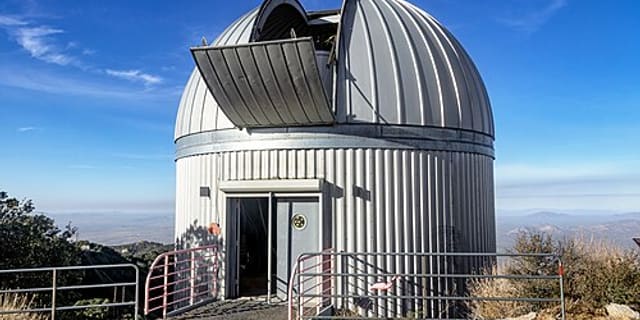
Image: Wikimedia Commons
Kitt Peak National Observatory rises from the Quinlan Mountains in the Arizona-Sonoran Desert, on land of the Tohono O'odham Nation, about 88 kilometres west-southwest of Tucson, Arizona.
About Kitt Peak National Observatory
Founded in 1958, Kitt Peak National Observatory (KPNO) is one of the largest gatherings of astronomical instruments anywhere in the Earth's northern hemisphere, with more than twenty optical telescopes and two radio telescopes sharing the mountain-top site.
History
The observatory was administered by the National Optical Astronomy Observatory (NOAO) from the early 1980s until 2019, when oversight passed to NOIRLab. In June 2022, the Contreras Fire forced an evacuation of the site and reached the summit, destroying four non-scientific buildings including a dormitory. Kitt Peak reopened to the public in September 2023, fifteen months later.
Telescopes & research
Kitt Peak is home to what was, for a time, the largest solar telescope in the world, alongside many of the large astronomical telescopes built in the United States during the late 20th century. The sheer density of instruments on one mountain makes it a working hub for a wide range of optical and radio astronomy programmes.
Location & getting there
Sitting at an elevation of 2,096 metres in the Sonoran Desert, Kitt Peak benefits from high altitude, dry air, and distance from city light pollution, the same conditions that made it an attractive site for so many telescopes in the first place. It's a manageable drive southwest of Tucson, Arizona.
Visiting Kitt Peak National Observatory
The observatory is open to the public and run today under NOIRLab; check the official website for current tour schedules, visitor centre hours, and ticketing before you go, especially given the site's history of wildfire-related closures.
See your named star from here
With more than twenty telescopes trained on the sky, Kitt Peak is exactly the kind of place where a named star from Star Register comes to life. Look up its coordinates in our star catalogue and see how it sits among the instruments here.
Opening hours and public-visit programs vary by season. Check the official website and Google Maps for current times before you travel.
Institutional and reference sources used to verify this guide.
Satellite imagery: Esri, Maxar, Earthstar Geographics

 under 1 km
Desert Beaver Observatory
a private astronomical observatory near Eloy, Arizona