
Infrared Optical Telescope Array

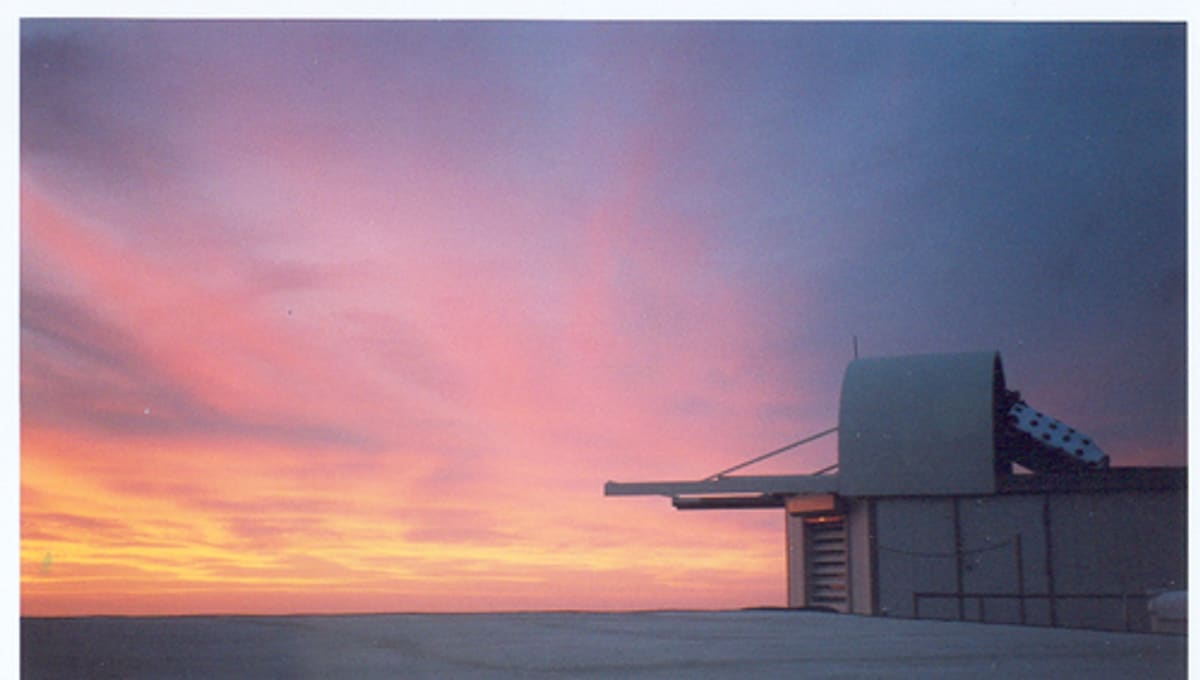
Image: Wikimedia Commons
The Infrared Optical Telescope Array (IOTA) was a stellar interferometer that operated at the Fred Lawrence Whipple Observatory in Santa Cruz County, Arizona, from the 1990s until 2006.
About the Infrared Optical Telescope Array
IOTA began under a 1988 agreement among five institutions — the Smithsonian Astrophysical Observatory, Harvard University, the University of Massachusetts Amherst, the University of Wyoming, and MIT/Lincoln Laboratory — to build a two-telescope stellar interferometer for fundamental astrophysical observations, and as a prototype for future, larger interferometric arrays.
History
On-site construction ran through 1993 and 1994, with the array achieving first fringes in December 1993. A third telescope came online in 2000, enabling closure phase observations and, for the first time at IOTA, aperture synthesis imaging. The array was decommissioned and disassembled in the summer of 2006 after funding ended.
Telescopes & research
As an interferometer, IOTA combined light from multiple telescopes to achieve angular resolution far beyond that of any single instrument, work that helped develop techniques later used in larger interferometric arrays.
Location & getting there
The array's site was in Santa Cruz County, Arizona, United States, at the Fred Lawrence Whipple Observatory.
Visiting the Infrared Optical Telescope Array
IOTA no longer operates, having been dismantled in 2006; visitors interested in the site today should look to the Fred Lawrence Whipple Observatory, which remains active.
See your named star from here
Even though IOTA itself is gone, the Arizona skies it once studied remain some of the best for stargazing. If you've named a star, find its coordinates in the star catalogue and locate it with a telescope at a nearby observing site.
Opening hours and public-visit programs vary by season. Check the official website and Google Maps for current times before you travel.
Institutional and reference sources used to verify this guide.
Satellite imagery: Esri, Maxar, Earthstar Geographics