
Hopkins Observatory

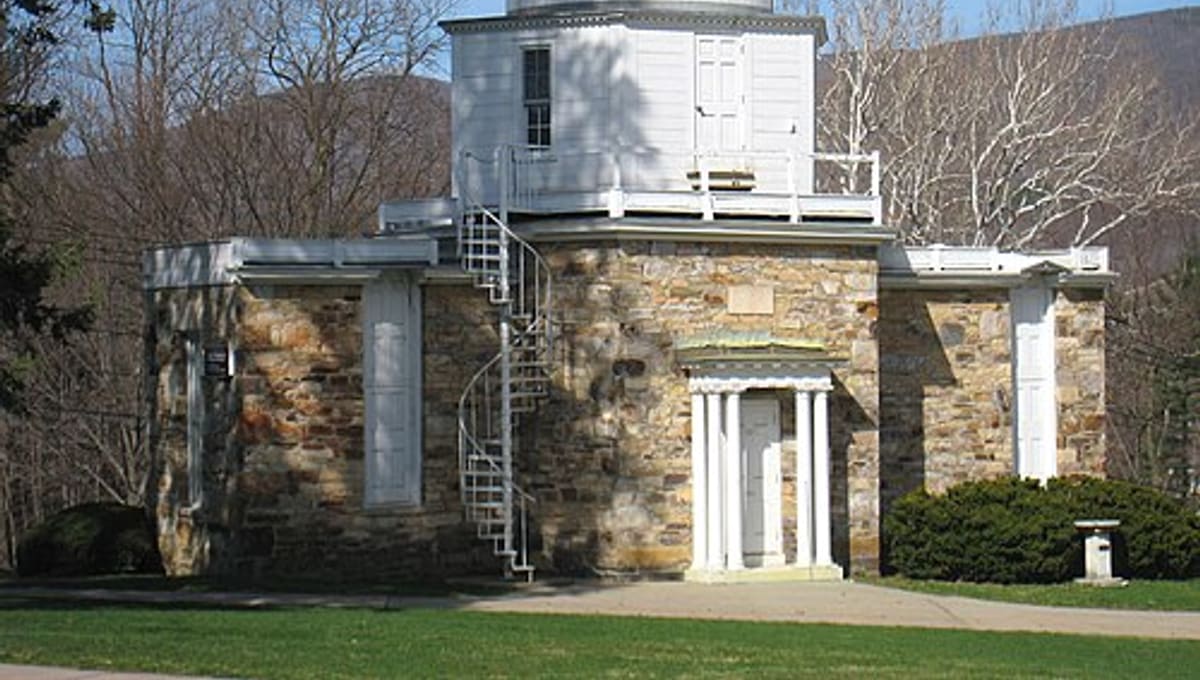
Image: Wikimedia Commons
Hopkins Observatory is the oldest surviving observatory in the United States, standing on the campus of Williams College in Williamstown, Massachusetts.
About Hopkins Observatory
Owned and operated by Williams College, the observatory now serves as a planetarium and houses the Mehlin Museum of Astronomy, dedicated to the memory of Professor Theodore Mehlin, who taught astronomy at the college from 1942 to 1971. Its planetarium projector, installed in 1963, is named for Willis Milham, who held the astronomy chair from 1901 to 1942.
History
Professor Albert Hopkins travelled to England in 1834 to acquire astronomical equipment, and his students built the original observatory between 1836 and 1838 in the centre of the college quad, making it the oldest extant observatory in the United States. It was relocated once in 1908 and again, to its present site, in 1961. The building still holds its original transit instrument, a mercury-compensated pendulum regulator, and a measuring rule, alongside a 7-inch refracting telescope built by Alvan Clark in 1852 and later restored for the observatory's sesquicentennial. The observatory's second director, Truman Henry Safford, was noted as a calculating prodigy.
Telescopes & research
The observatory's centrepiece is its 1852 Alvan Clark 7-inch refractor, one of the earliest surviving instruments from that celebrated telescope-making firm, still housed alongside the original 1838 transit and regulator.
Location & getting there
Hopkins Observatory sits on the Williams College campus in Williamstown, in the Berkshire hills of western Massachusetts.
Visiting Hopkins Observatory
As part of Williams College, the observatory and its planetarium host public programming; check the college astronomy department's website for current opening hours and show schedules before visiting.
See your named star from here
Standing where American astronomy began, Hopkins Observatory is a fitting spot to look for a star named in someone's honour. Find your star's coordinates in the star catalogue or start a new dedication through Star Register's packages.
Opening hours and public-visit programs vary by season. Check the official website and Google Maps for current times before you travel.
Institutional and reference sources used to verify this guide.
Satellite imagery: Esri, Maxar, Earthstar Geographics

 45 km
45 km
 84 km
84 km