
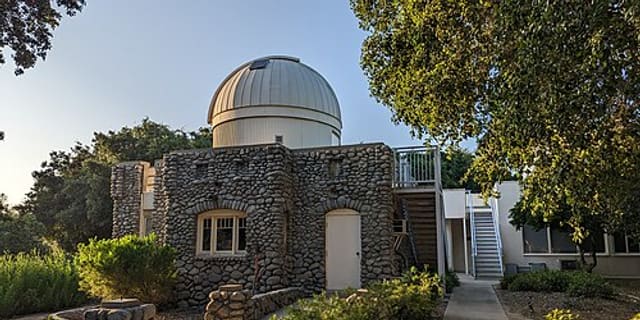
Hooker Telescope

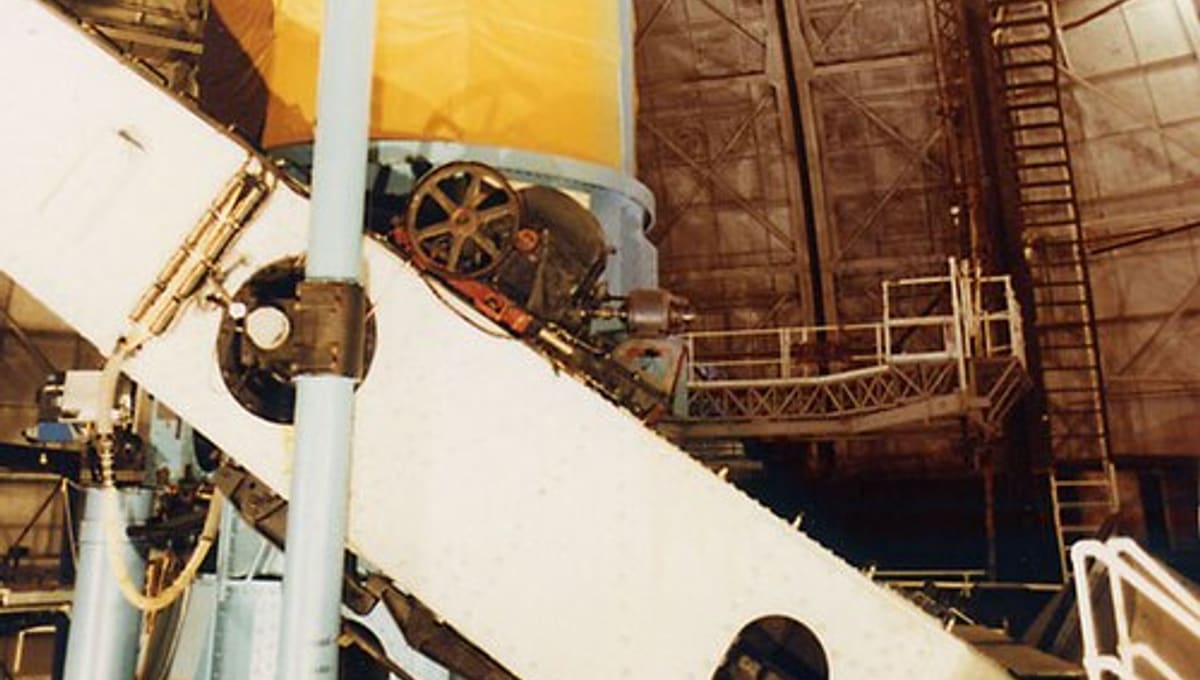
Image: Wikimedia Commons
The Hooker Telescope is the historic 100-inch (2.5-metre) reflector at Mount Wilson Observatory in the San Gabriel Mountains above Pasadena, California.
About Hooker Telescope
Completed in 1917, with first light on 2 November of that year, the Hooker Telescope was the largest telescope in the world for more than three decades, holding the title until 1949.
History
The Hooker Telescope's decades at the frontier of astronomy produced some of the twentieth century's most important discoveries. In 1923, Edwin Hubble used it to prove that the Andromeda nebula lay far outside the Milky Way, and in 1929 Hubble and Milton Humason used its observations to demonstrate that the universe is expanding and to measure the rate of that expansion. In the 1930s and 1940s, Fritz Zwicky found evidence for what is now called dark matter, and Walter Baade distinguished different populations of stars, while in 1963 the telescope was used to detect water vapour on Mars.
Location & getting there
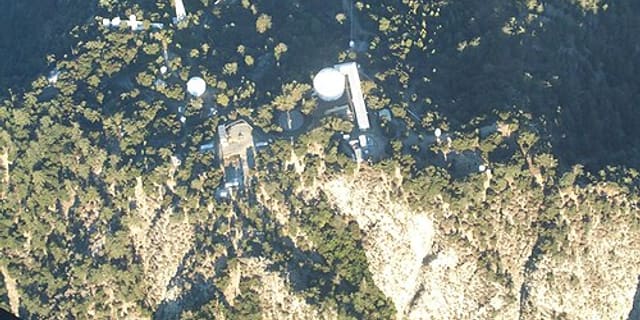
The telescope sits on Mount Wilson peak in the San Gabriel Mountains, part of Mount Wilson Observatory near Pasadena, California, in the United States.
Visiting Hooker Telescope
As part of Mount Wilson Observatory, visiting arrangements for the historic dome are best confirmed directly with the observatory before you travel.
See your named star from here
The same night sky that revealed the expanding universe through the Hooker Telescope holds countless more stars still waiting to be named. Explore the star catalogue or start with Star Register's packages to name one of your own, then watch for it above Mount Wilson or wherever the sky is dark enough.
Opening hours and public-visit programs vary by season. Check Google Maps for current times before you travel.
Institutional and reference sources used to verify this guide.
Satellite imagery: Esri, Maxar, Earthstar Geographics

 under 1 km
Mount Wilson Observatory
astronomical observatory in Los Angeles County, California

 10 km
10 km
 25 km
25 km
 36 kmResearch