
Guillermo Haro Observatory

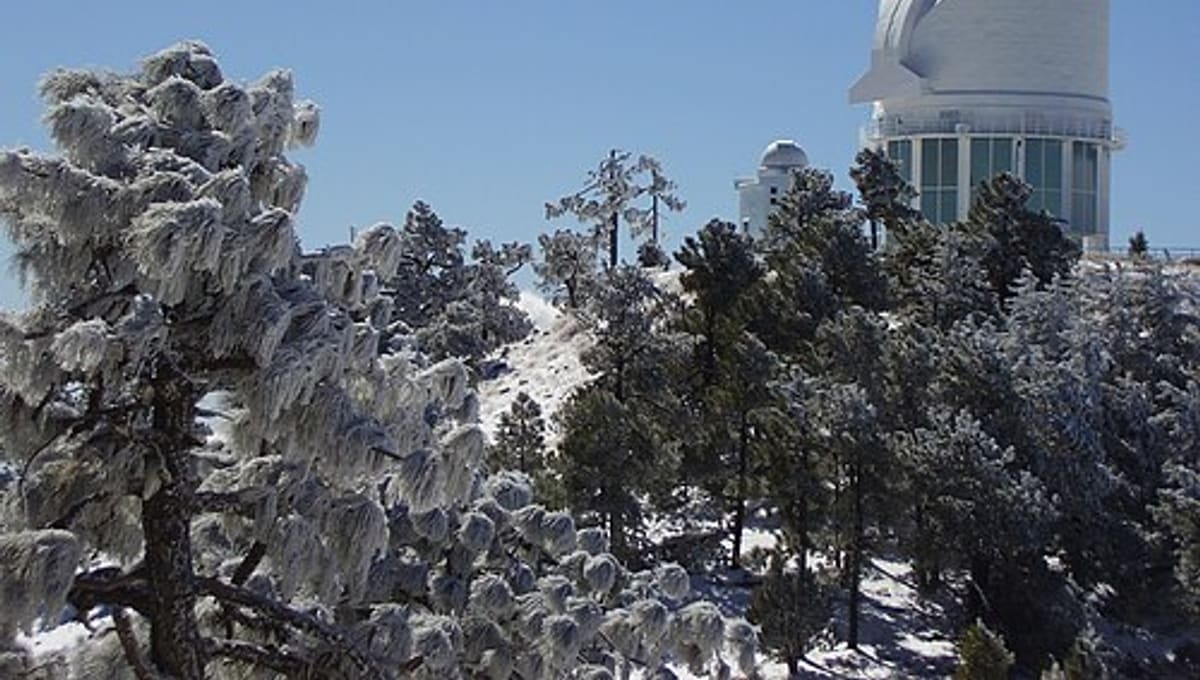
Image: Wikimedia Commons
The Guillermo Haro Observatory rises above the hills near Cananea, in the northern Mexican state of Sonora, where astronomers have studied the sky since the late 1980s.
About Guillermo Haro Observatory
Formally the Observatorio Astrofísico Guillermo Haro (OAGH), the site is owned and operated by Mexico's National Institute of Astrophysics, Optics and Electronics (INAOE). It sits 13 km north of Cananea and about 85 km southeast of Mount Hopkins in Arizona, and takes its name from the pioneering Mexican scientist Guillermo Haro.
History
OAGH was inaugurated on 8 September 1987, with regular scientific operations beginning in 1992.
Telescopes & research
The observatory's main instrument is a 2.12-metre (83-inch) Ritchey-Chrétien reflector paired with a 0.5-metre secondary mirror. Over the years it has been fitted with a Direct Camera, an LFSOC spectrophotometer, a Boller spectrograph, a near-infrared camera, and the CANHIS spectrograph, and it also supports remote observing for researchers working off-site.
Location & getting there
Sited in the highlands near Cananea, Sonora, in northern Mexico, the observatory benefits from the dark, dry skies typical of the region. Use the map on this page for exact coordinates and directions from Cananea.
Visiting Guillermo Haro Observatory
OAGH is a working research facility rather than a public visitor centre. Group visits and educational tours are occasionally arranged through INAOE; check the observatory's official website and confirm current arrangements directly with INAOE before planning a visit.
See your named star from here
Because OAGH's 2.12-metre reflector can be pointed at any set of celestial coordinates, staff can in principle observe the exact position of a star named through Star Register. Name a star to get its right ascension and declination, or explore the star catalogue to see stars already named by others.
Opening hours and public-visit programs vary by season. Check the official website and Google Maps for current times before you travel.
Institutional and reference sources used to verify this guide.
Satellite imagery: Esri, Maxar, Earthstar Geographics