
Goethe Link Observatory

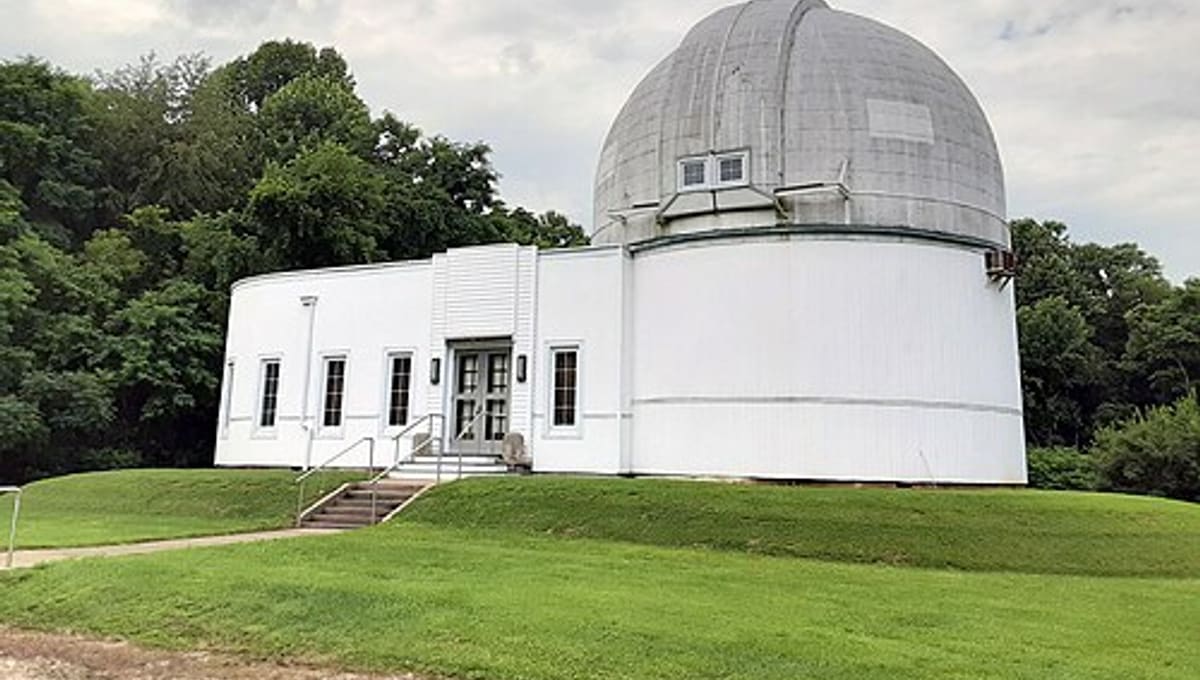
Image: Wikimedia Commons
Near Brooklyn, Indiana, the Goethe Link Observatory has borne the name of the Indianapolis surgeon and amateur astronomer who built it with his own funds, and later became the site of one of the more productive amateur asteroid-hunting programmes in American astronomy.
About Goethe Link Observatory
Registered internationally under observatory code 760, the facility sits near Brooklyn, Indiana, at an elevation of 293 metres, with its address at 8403 Observatory Ln, Martinsville, IN. It is owned by Indiana University and operated by the Indiana Astronomical Society, a group dedicated to amateur astronomy.
History
Construction began in 1937, funded privately by Dr. Goethe Link, and the telescope first saw use in 1939. Link donated the observatory to Indiana University in 1948. From 1949 to 1966, the university ran its Indiana Asteroid Program from the site using a 10-inch Cooke triplet astrograph at f/6.5, discovering 119 asteroids credited by the Minor Planet Center to "Indiana University." Two of them were later named for the observatory and its founder: 1602 Indiana, discovered in 1950, and 1728 Goethe Link, discovered in 1964. As light pollution reduced the site's usefulness in the 1960s, the university built the Morgan-Monroe Station in the Morgan-Monroe State Forest, which it operated until around 2014; today Indiana University's primary research instruments are the WIYN telescopes at Kitt Peak National Observatory in Arizona.
Telescopes & research
The observatory's defining instrument was its 10-inch Cooke triplet astrograph, the workhorse of the Indiana Asteroid Program and the source of its 119 asteroid discoveries.
Location & getting there
Goethe Link Observatory sits near Brooklyn, Indiana, in the North America region, at 293 metres elevation, with its address at 8403 Observatory Ln, Martinsville, IN 46151.
Visiting Goethe Link Observatory
The Indiana Astronomical Society hosts events at the observatory during and after its general meetings. Check the society's website, or Indiana University's observatory page, for the current schedule before visiting.
See your named star from here
An observatory that once tracked down 119 asteroids knows exactly what to do with a set of coordinates. If you've named a star with Star Register, its certificate provides the position needed to find it. Browse the star catalogue to find yours.
Opening hours and public-visit programs vary by season. Check the official website and Google Maps for current times before you travel.
Institutional and reference sources used to verify this guide.
Satellite imagery: Esri, Maxar, Earthstar Geographics

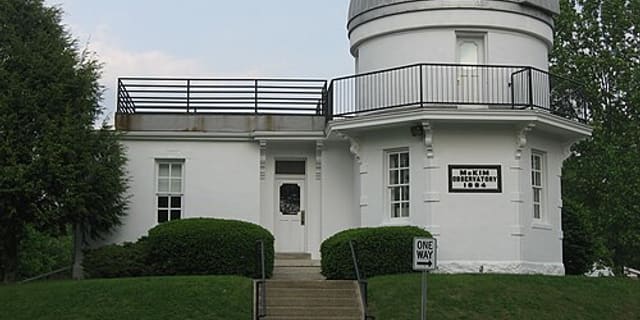 41 km
41 km
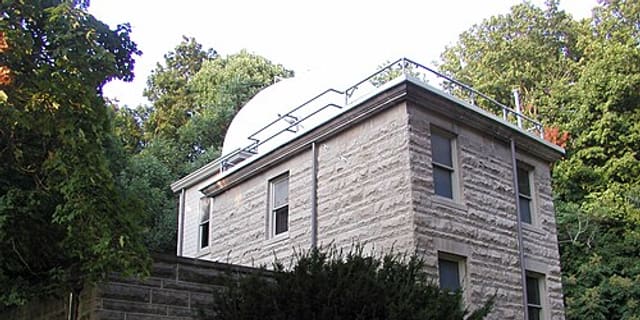 44 km
44 kmKirkwood Observatory
astronomical observatory near Bloomingon, in the US state of Indiana