
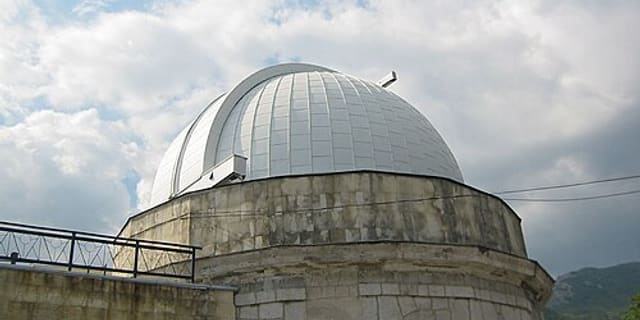
Evpatoria Observatory


Image: Wikimedia Commons
Near Yevpatoria in Crimea, the RT-70 radio telescope was once one of the largest fully steerable radar dishes on Earth, famous both for probing the planets and for sending messages toward the stars.
About Evpatoria Observatory
Also known as the Evpatoria Planetary Radar (EPR) or P-2500, the RT-70 was a 70-metre-diameter, 86-metre-tall antenna weighing roughly 5,000 tons, operated by the Center for Deep Space Communications. It was one of only two radio telescopes in the world capable of transmitting powerful messages toward other stars, and it supported interplanetary missions to Venus and Mars as well as research on quasars, the solar wind and asteroids.
History
The telescope carried out notable projects such as the Cosmic Call transmissions between 1999 and 2003, the Teen Age Message sent in 2001 and a message to the star Gliese 581c sent in 2008. Following Russia's annexation of Crimea in 2014, the facility was taken over and converted to military use with Russian upgrades. It was destroyed in a drone attack in June 2024.
Location & getting there
The site is in Europe, near Yevpatoria in Crimea, a region currently affected by conflict.
Visiting Evpatoria Observatory
The facility is no longer operating as an observatory and is not accessible to visitors.
See your named star from here
The RT-70 once sent messages toward specific stars using precise coordinates. A star named through Star Register comes with those same kinds of coordinates, so you can track it down wherever you are. Name a star or search the star catalogue.
Opening hours and public-visit programs vary by season. Check Google Maps for current times before you travel.
Institutional and reference sources used to verify this guide.
Satellite imagery: Esri, Maxar, Earthstar Geographics

 83 km
83 kmMobil Astronomical Robotics Genon Observatory
astronomical observatory owned by Gennadiy Borisov

 83 km
83 km
 107 kmResearch
 219 km