
Dunsink Observatory


Image: Wikimedia Commons
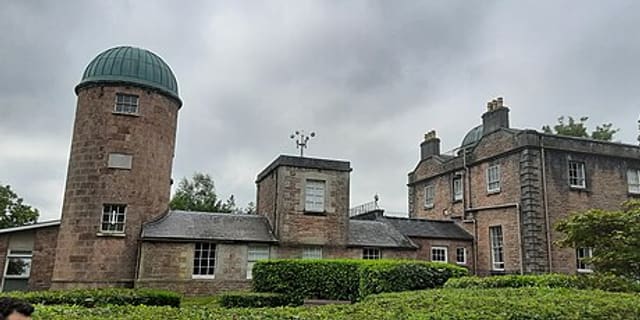
Just outside Dublin in the townland of Dunsink, Dunsink Observatory has watched the Irish sky since 1785, making it one of the oldest working observatories in the world. Today it is run by the Dublin Institute for Advanced Studies (DIAS) as both a research centre and a public window onto astronomy.
About Dunsink Observatory
Dunsink is home to around 35 researchers working across solar and stellar physics, space weather, planetary science, star formation, the interstellar medium and high-energy astrophysics. The observatory also contributes to major international missions, including NASA's James Webb Space Telescope and ESA's Solar Orbiter.
History
Founded in 1785, Dunsink is best remembered for astronomer William Rowan Hamilton, a former director who discovered quaternions — the first non-commutative algebra — while walking from the observatory into Dublin with his wife. The Hamilton Walk, an annual event retracing that route, still begins at the observatory today.
Telescopes & research
The site's historic Grubb Telescope and ADH Telescope remain in use for observation and public demonstrations. Beyond astronomy, Dunsink also hosts weather monitoring for Met Éireann, the Magnetic Network of Ireland (MagIE) for geomagnetic recording, and SuperSID ionospheric observations, alongside the SFI Curious Minds Discover Centre for public science engagement.
Location & getting there
The observatory sits on the northwestern outskirts of Dublin, Ireland, within easy reach of the city centre, in a parkland setting that still offers a working night sky for observation and events.
Visiting Dunsink Observatory
Dunsink regularly opens for public events, tours and educational programmes through its Discover Centre. Opening times vary by event, so check the official Dunsink Observatory website before travelling.
See your named star from here
If you've named a star through Star Register, staff and volunteers at an observatory like Dunsink can help point a telescope toward its exact coordinates on request. Look up any star's right ascension and declination in our star catalogue to plan a viewing.
Opening hours and public-visit programs vary by season. Check the official website and Google Maps for current times before you travel.
Institutional and reference sources used to verify this guide.
Satellite imagery: Esri, Maxar, Earthstar Geographics
South Meridian Marker
observatory in Ballyheridan, County Armagh, Northern Ireland

 109 km